Ch. 7 - Transcendental Functions
Hass - Thomas' Calculus 15th Edition
Hass15th EditionThomas' CalculusISBN: 9780137616077Not the one you use?Change textbook
Chapter 7, Problem 7.4.44

44. Silver cooling in air The temperature of an ingot of silver is 60°C above room temperature right now. Twenty minutes ago, it was 70°C above room temperature. How far above room temperature will the silver be
b. 2 hours from now?

Verified step by step guidance
1
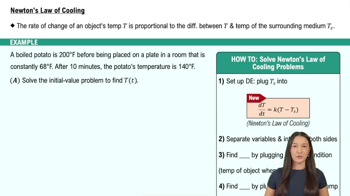
Identify the problem as an application of Newton's Law of Cooling, which states that the rate of change of temperature of an object is proportional to the difference between its temperature and the ambient temperature (room temperature in this case). The formula is: \[\frac{dT}{dt} = -k (T - T_{room})\] where \(T\) is the temperature of the object, \(T_{room}\) is the room temperature, and \(k\) is a positive constant.
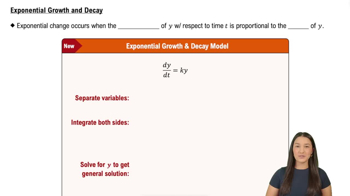
Express the temperature difference from room temperature as a function of time: let \[y(t) = T(t) - T_{room}\]. Then Newton's Law of Cooling simplifies to \[\frac{dy}{dt} = -k y\], which is a first-order linear differential equation.
Solve the differential equation to get the general solution: \[y(t) = y_0 e^{-k t}\], where \(y_0\) is the initial temperature difference at time \(t=0\). Here, you need to define your time reference point carefully. For example, let \(t=0\) be the current time, so \(y(0) = 60\)°C.
Use the information from 20 minutes ago to find the constant \(k\). Since 20 minutes ago corresponds to \(t = -20\( minutes, and the temperature difference then was 70°C, set up the equation: \[y(-20) = 70 = 60 e^{20 k}\]. Solve this equation for \)k\).
Once \(k\( is found, use the formula \[y(t) = 60 e^{-k t}\] to find the temperature difference 2 hours (120 minutes) from now by substituting \)t = 120\). This will give the temperature difference above room temperature at that time.

Verified video answer for a similar problem:

This video solution was recommended by our tutors as helpful for the problem above.
Video duration:
7m
Was this helpful?

Key Concepts

Here are the essential concepts you must grasp in order to answer the question correctly.

Newton's Law of Cooling

Newton's Law of Cooling describes how the temperature of an object changes over time as it approaches the ambient temperature. It states that the rate of temperature change is proportional to the difference between the object's temperature and the surrounding temperature.
Recommended video:
10:44
Newton's Law of Cooling

Exponential Decay Model

The temperature difference between the object and the environment decreases exponentially over time. This model uses an exponential function to represent how the temperature approaches room temperature, typically expressed as T(t) = T_env + (T_initial - T_env) * e^(-kt).
Recommended video:
09:29
Exponential Growth & Decay

Determining the Cooling Constant

The cooling constant (k) quantifies how quickly the object cools and can be found using known temperature values at specific times. By substituting given temperatures and times into the exponential decay formula, k can be solved, enabling prediction of future temperatures.
Recommended video:
10:44
Newton's Law of Cooling