Ch. 7 - Transcendental Functions
Hass - Thomas' Calculus 15th Edition
Hass15th EditionThomas' CalculusISBN: 9780137616077Not the one you use?Change textbook
Chapter 7, Problem 7.5.82

82. For what values of a and b is
lim(x→0)(tan(2x/x³) + a/x² + sin(bx)/x) = 0?

Verified step by step guidance
1
Rewrite the limit expression clearly: \(\lim_{x \to 0} \left( \tan\left( \frac{2x}{x^3} \right) + \frac{a}{x^2} + \frac{\sin(bx)}{x} \right) = 0\).
Simplify the argument inside the tangent function: \(\frac{2x}{x^3} = \frac{2}{x^2}\). So the expression becomes \(\tan\left( \frac{2}{x^2} \right) + \frac{a}{x^2} + \frac{\sin(bx)}{x}\).
Analyze the behavior of each term as \(x \to 0\). Notice that \(\tan\left( \frac{2}{x^2} \right)\) oscillates wildly and does not have a limit, so for the overall limit to exist and be zero, the terms involving \(a\) and \(b\) must cancel or control the behavior.
Consider using series expansions or asymptotic behavior for \(\sin(bx)\) near zero: \(\sin(bx) \approx bx\) for small \(x\), so \(\frac{\sin(bx)}{x} \approx b\). This term tends to \(b\) as \(x \to 0\).
Since \(\tan\left( \frac{2}{x^2} \right)\) does not have a limit, the only way for the entire limit to be zero is if the expression inside the limit is defined differently or if the problem is reconsidered. Re-examine the problem statement or check for possible typos in the expression.

Verified video answer for a similar problem:

This video solution was recommended by our tutors as helpful for the problem above.
Video duration:
3m
Was this helpful?

Key Concepts

Here are the essential concepts you must grasp in order to answer the question correctly.

Limit of a Function as x Approaches a Point

The limit describes the value a function approaches as the input approaches a specific point. Understanding how to evaluate limits, especially when direct substitution leads to indeterminate forms, is essential for analyzing behavior near that point.
Recommended video:
06:11
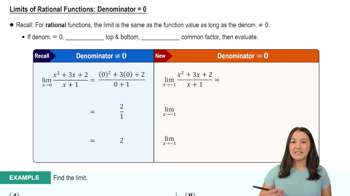
Limits of Rational Functions: Denominator = 0

Series Expansion (Taylor or Maclaurin Series)

Series expansions approximate functions near a point using polynomials. For small x, functions like tan(2x), sin(bx), and powers of x can be expanded to simplify complex expressions and identify dominant terms affecting the limit.
Recommended video:
08:26
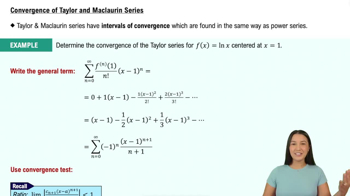
Convergence of Taylor & Maclaurin Series

Handling Indeterminate Forms and Coefficient Matching

When limits yield expressions like 0/0 or ∞ - ∞, rewriting terms via expansions helps resolve indeterminacies. Matching coefficients of powers of x ensures the limit exists and equals the desired value, allowing determination of unknown parameters a and b.
Recommended video:
6:04
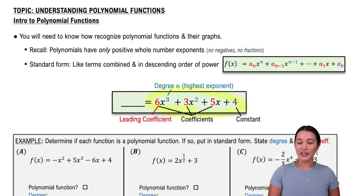
Introduction to Polynomial Functions