Ch. 7 - Transcendental Functions
Hass - Thomas' Calculus 15th Edition
Hass15th EditionThomas' CalculusISBN: 9780137616077Not the one you use?Change textbook
Chapter 7, Problem 7.6.108

L’Hôpital’s Rule
Find the limits in Exercises 103–110.
108. lim(x→∞)(e^x arctan(e^x))/(e^(2x)+x)

Verified step by step guidance
1
Identify the limit expression: \(\lim_{x \to \infty} \frac{e^{x} \arctan(e^{x})}{e^{2x} + x}\).
Check the behavior of numerator and denominator as \(x \to \infty\): \(e^{x} \to \infty\), \(\arctan(e^{x}) \to \frac{\pi}{2}\), so numerator behaves like \(\infty \cdot \frac{\pi}{2} = \infty\). Denominator \(e^{2x} + x \to \infty\). So the limit is of the form \(\frac{\infty}{\infty}\), which is an indeterminate form suitable for L’Hôpital’s Rule.
Apply L’Hôpital’s Rule by differentiating numerator and denominator separately with respect to \(x\):
Numerator derivative: Use product rule on \(e^{x} \arctan(e^{x})\):
\[\frac{d}{dx} \left(e^{x} \arctan(e^{x})\right) = e^{x} \arctan(e^{x}) + e^{x} \cdot \frac{1}{1 + (e^{x})^{2}} \cdot e^{x} = e^{x} \arctan(e^{x}) + \frac{e^{2x}}{1 + e^{2x}}.\]
Denominator derivative: \(\frac{d}{dx} (e^{2x} + x) = 2 e^{2x} + 1\).

Verified video answer for a similar problem:

This video solution was recommended by our tutors as helpful for the problem above.
Video duration:
5m
Was this helpful?

Key Concepts

Here are the essential concepts you must grasp in order to answer the question correctly.

L’Hôpital’s Rule

L’Hôpital’s Rule is a method for evaluating limits that result in indeterminate forms like 0/0 or ∞/∞. It states that the limit of a ratio of functions can be found by taking the limit of the ratio of their derivatives, provided certain conditions are met. This rule simplifies complex limits involving exponential, logarithmic, or trigonometric functions.
Recommended video:

Behavior of Exponential and Inverse Trigonometric Functions at Infinity

Understanding how functions like e^x and arctan(e^x) behave as x approaches infinity is crucial. Exponential functions grow rapidly without bound, while arctan approaches a finite horizontal asymptote (π/2). Recognizing these behaviors helps in simplifying and evaluating limits involving these functions.
Recommended video:
06:35
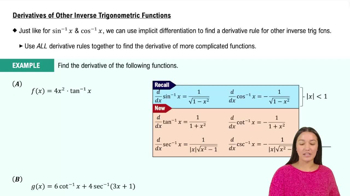
Derivatives of Other Inverse Trigonometric Functions

Dominant Terms in Limits

When evaluating limits as x approaches infinity, identifying the dominant terms in the numerator and denominator is essential. Terms with the highest growth rates determine the limit's behavior. Comparing exponential growth rates and polynomial terms helps simplify the expression before applying limit laws or L’Hôpital’s Rule.
Recommended video:
05:50
One-Sided Limits