Ch. 7 - Transcendental Functions
Hass - Thomas' Calculus 15th Edition
Hass15th EditionThomas' CalculusISBN: 9780137616077Not the one you use?Change textbook
Chapter 7, Problem 7.7.6

Rewrite the expressions in Exercises 5–10 in terms of exponentials and simplify the results as much as you can.
6. sinh(2ln x)

Verified step by step guidance
1
Recall the definition of the hyperbolic sine function: \(\sinh(y) = \frac{e^{y} - e^{-y}}{2}\).
Substitute \(y = 2 \ln x\) into the definition: \(\sinh(2 \ln x) = \frac{e^{2 \ln x} - e^{-2 \ln x}}{2}\).
Use the property of exponentials and logarithms: \(e^{2 \ln x} = (e^{\ln x})^{2} = x^{2}\) and similarly \(e^{-2 \ln x} = (e^{\ln x})^{-2} = x^{-2}\).
Rewrite the expression using these simplifications: \(\sinh(2 \ln x) = \frac{x^{2} - x^{-2}}{2}\).
Express the final simplified form clearly: \(\sinh(2 \ln x) = \frac{x^{2} - \frac{1}{x^{2}}}{2}\).

Verified video answer for a similar problem:

This video solution was recommended by our tutors as helpful for the problem above.
Video duration:
2m
Was this helpful?

Key Concepts

Here are the essential concepts you must grasp in order to answer the question correctly.

Hyperbolic Sine Function (sinh)

The hyperbolic sine function, sinh(x), is defined as (e^x - e^(-x))/2. It relates exponential functions to hyperbolic trigonometry and is essential for rewriting expressions involving sinh in terms of exponentials.
Recommended video:
5:53
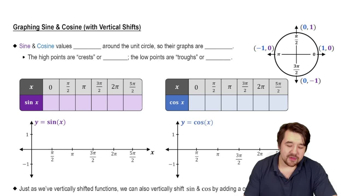
Graph of Sine and Cosine Function

Properties of Logarithms

Logarithms, especially natural logs (ln), allow expressions like ln(x^a) = a ln(x). Understanding how to manipulate ln expressions helps simplify arguments inside functions before rewriting them in exponential form.
Recommended video:
05:36
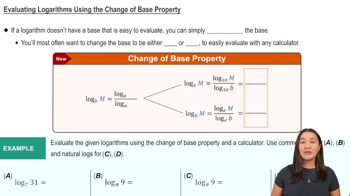
Change of Base Property

Exponential Simplification

After rewriting expressions using exponentials, simplifying involves applying exponent rules such as e^(a+b) = e^a * e^b and e^(ln x) = x. This step reduces complex expressions to simpler forms.
Recommended video:
6:13
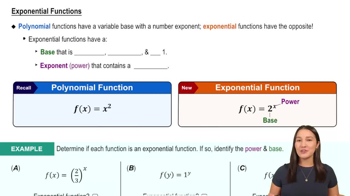
Exponential Functions