Ch. 4 - Applications of Derivatives
Hass - Thomas' Calculus 15th Edition
Hass15th EditionThomas' CalculusISBN: 9780137616077Not the one you use?Change textbook
Chapter 4, Problem 4.3.68b

Theory and Examples


Sketch the graph of a differentiable function y = f(x) that has a local maximum at (1, 1) and a local minimum at (3, 3).

Verified step by step guidance
1
Start by understanding the characteristics of a differentiable function. A differentiable function is smooth and has no sharp corners or discontinuities. This means the function has a derivative at every point in its domain.
Identify the points where the local maximum and minimum occur. The problem states that there is a local maximum at (1, 1) and a local minimum at (3, 3). At these points, the derivative of the function will be zero, indicating horizontal tangents.
Consider the behavior of the function around the local maximum at (1, 1). As x approaches 1 from the left, the function should be increasing, and as x moves past 1 to the right, the function should be decreasing. This creates a peak at x = 1.
Similarly, analyze the behavior around the local minimum at (3, 3). As x approaches 3 from the left, the function should be decreasing, and as x moves past 3 to the right, the function should be increasing. This creates a trough at x = 3.
Sketch the graph by connecting these points smoothly, ensuring the function increases towards the local maximum, decreases after it, and then decreases towards the local minimum, increasing after it. The graph should reflect the smooth transition between these critical points, maintaining differentiability.

Verified video answer for a similar problem:

This video solution was recommended by our tutors as helpful for the problem above.
Video duration:
6m
Was this helpful?

Key Concepts

Here are the essential concepts you must grasp in order to answer the question correctly.

Differentiable Function

A differentiable function is one that has a derivative at every point in its domain. This implies the function is smooth and continuous, without any sharp corners or discontinuities. Understanding differentiability is crucial for sketching graphs, as it ensures the function's behavior can be predicted using its derivative.
Recommended video:
05:53
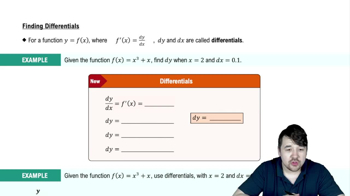
Finding Differentials

Local Maximum

A local maximum occurs at a point where the function value is greater than or equal to the values of the function at nearby points. At a local maximum, the derivative changes from positive to negative, indicating a peak in the graph. Recognizing local maxima helps in identifying the turning points of the function.
Recommended video:
06:02
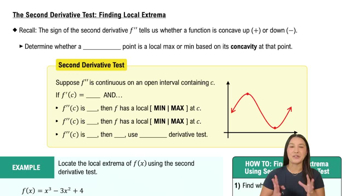
The Second Derivative Test: Finding Local Extrema

Local Minimum

A local minimum is a point where the function value is less than or equal to the values of the function at nearby points. At a local minimum, the derivative changes from negative to positive, indicating a trough in the graph. Identifying local minima is essential for understanding the function's valleys and overall shape.
Recommended video:
06:02
The Second Derivative Test: Finding Local Extrema