Ch. 4 - Applications of Derivatives
Hass - Thomas' Calculus 15th Edition
Hass15th EditionThomas' CalculusISBN: 9780137616077Not the one you use?Change textbook
Chapter 4, Problem 4.4.114b

114. Parabolas
b. When is the parabola concave up? Concave down?

Verified step by step guidance
1
To determine when a parabola is concave up or concave down, we need to look at the second derivative of its equation. A parabola is typically given by the quadratic function \( f(x) = ax^2 + bx + c \).
The second derivative of the function \( f(x) = ax^2 + bx + c \) is \( f''(x) = 2a \). This is a constant value, meaning it does not depend on \( x \).
A parabola is concave up when the second derivative is positive. Therefore, if \( 2a > 0 \), the parabola is concave up. This simplifies to \( a > 0 \).
Conversely, a parabola is concave down when the second derivative is negative. Therefore, if \( 2a < 0 \), the parabola is concave down. This simplifies to \( a < 0 \).
In summary, the concavity of a parabola is determined by the sign of the coefficient \( a \) in the quadratic function. If \( a > 0 \), the parabola is concave up, and if \( a < 0 \), it is concave down.

Verified video answer for a similar problem:

This video solution was recommended by our tutors as helpful for the problem above.
Video duration:
1m
Was this helpful?

Key Concepts

Here are the essential concepts you must grasp in order to answer the question correctly.

Parabola

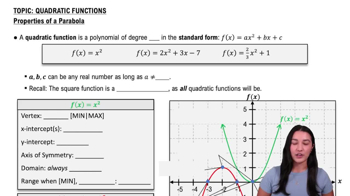
A parabola is a U-shaped curve that can open upwards or downwards, defined by a quadratic function of the form y = ax^2 + bx + c. The direction in which the parabola opens is determined by the sign of the coefficient 'a'. If 'a' is positive, the parabola opens upwards; if 'a' is negative, it opens downwards.
Recommended video:
7:42
Properties of Parabolas

Concavity

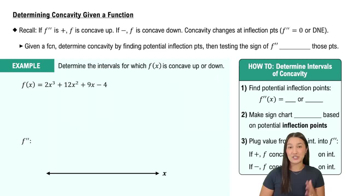
Concavity refers to the direction in which a curve bends. A function is concave up if it bends upwards like a cup, and concave down if it bends downwards like a cap. For a parabola, concavity is determined by the sign of the leading coefficient 'a' in the quadratic equation: positive 'a' indicates concave up, while negative 'a' indicates concave down.
Recommended video:
05:59
Determining Concavity Given a Function

Second Derivative Test

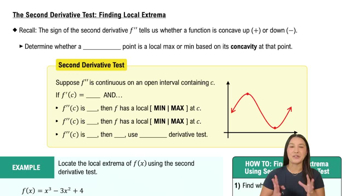
The second derivative test is used to determine the concavity of a function. For a quadratic function y = ax^2 + bx + c, the second derivative is a constant, 2a. If 2a > 0, the function is concave up, and if 2a < 0, it is concave down. This test helps in identifying the nature of the parabola's curvature.
Recommended video:
06:02
The Second Derivative Test: Finding Local Extrema
Related Practice
Textbook Question

Finding Antiderivatives

In Exercises 1–16, find an antiderivative for each function. Do as many as you can mentally. Check your answers by differentiation.

1/(3³√x)

1
views

Textbook Question

Finding Antiderivatives

In Exercises 1–16, find an antiderivative for each function. Do as many as you can mentally. Check your answers by differentiation.

1 / 2x³

1
views
Textbook Question

Identifying Extrema


In Exercises 63 and 64, the graph of f' is given. Assume that f has domain (-2, 2).


" style="max-width: 100%; white-space-collapse: preserve;" width="190">


b. Either use the graph to determine which intervals f is positive on and which intervals f is negative on, or explain why this information cannot be determined from the graph.

Textbook Question

[Technology Exercise] 17. Designing a suitcase A 24-in.-by-36-in. sheet of cardboard is folded in half to form a 24-in.-by-18-in. rectangle as shown in the accompanying figure. Then four congruent squares of side length x are cut from the corners of the folded rectangle. The sheet is unfolded, and the six tabs are folded up to form a box with sides and a lid.

" style="" width="400">

b. Find the domain of V for the problem situation and graph V over this domain.

Textbook Question

Theory and Examples


Sketch the graph of a differentiable function y = f(x) that has a local maximum at (1, 1) and a local minimum at (3, 3).

Textbook Question

Finding Antiderivatives

In Exercises 1–16, find an antiderivative for each function. Do as many as you can mentally. Check your answers by differentiation.

4 sec 3x tan 3x

1
views