
Textbook Question
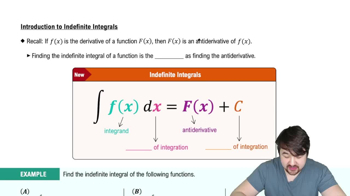
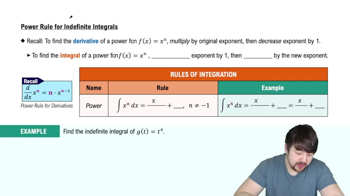
Finding Antiderivatives
In Exercises 1–16, find an antiderivative for each function. Do as many as you can mentally. Check your answers by differentiation.
1 / 2x³
1
views

 Verified step by step guidance
 05:04
05:04
 04:04
04:04 6:39
6:39Finding Antiderivatives
In Exercises 1–16, find an antiderivative for each function. Do as many as you can mentally. Check your answers by differentiation.
1 / 2x³
114. Parabolas
b. When is the parabola concave up? Concave down?
Identifying Extrema
In Exercises 63 and 64, the graph of f' is given. Assume that f has domain (-2, 2).
" style="max-width: 100%; white-space-collapse: preserve;" width="190">
b. Either use the graph to determine which intervals f is positive on and which intervals f is negative on, or explain why this information cannot be determined from the graph.
[Technology Exercise] 17. Designing a suitcase A 24-in.-by-36-in. sheet of cardboard is folded in half to form a 24-in.-by-18-in. rectangle as shown in the accompanying figure. Then four congruent squares of side length x are cut from the corners of the folded rectangle. The sheet is unfolded, and the six tabs are folded up to form a box with sides and a lid.
" style="" width="400">
b. Find the domain of V for the problem situation and graph V over this domain.
Identifying Extrema
In Exercises 19–40:
b. Identify the function’s local extreme values, if any, saying where they occur.
f(r) = 3r³ + 16r
Theory and Examples
Sketch the graph of a differentiable function y = f(x) that has a local maximum at (1, 1) and a local minimum at (3, 3).