
Textbook Question
Finding Antiderivatives
In Exercises 1–16, find an antiderivative for each function. Do as many as you can mentally. Check your answers by differentiation.
1/(3³√x)
1
views

 Verified step by step guidance
 07:09
07:09
 04:50
04:50 5:10
5:10Finding Antiderivatives
In Exercises 1–16, find an antiderivative for each function. Do as many as you can mentally. Check your answers by differentiation.
1/(3³√x)
Finding Antiderivatives
In Exercises 1–16, find an antiderivative for each function. Do as many as you can mentally. Check your answers by differentiation.
1 / 2x³
114. Parabolas
b. When is the parabola concave up? Concave down?
Theory and Examples
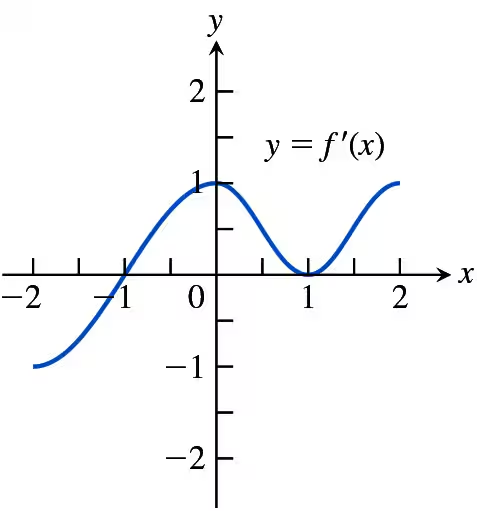
Sketch the graph of a differentiable function y = f(x) that has a local maximum at (1, 1) and a local minimum at (3, 3).
Analyzing Functions from Derivatives
Answer the following questions about the functions whose derivatives are given in Exercises 1–14:
b. On what open intervals is f increasing or decreasing?
f′(x) = x(x − 1)
Theory and Examples
Cubic functions Consider the cubic function f(x) = ax³ + bx² + cx + d.
b. How many local extreme values can f have?