Ch. 4 - Applications of Derivatives
Hass - Thomas' Calculus 15th Edition
Hass15th EditionThomas' CalculusISBN: 9780137616077Not the one you use?Change textbook
Chapter 4, Problem 4.7.65b

Checking Antiderivative Formulas


Right, or wrong? Say which for each formula and give a brief reason for each answer.


∫3(2x + 1)² dx = (2x + 1)³ + C

Verified step by step guidance
1
Identify the integral given: \(\int 3(2x + 1)^2 \, dx\).
Recognize that the integrand is a composite function, so consider using substitution. Let \(u = 2x + 1\).
Compute the derivative of \(u\) with respect to \(x\): \(\frac{du}{dx} = 2\), which implies \(dx = \frac{du}{2}\).
Rewrite the integral in terms of \(u\): \(\int 3u^2 \cdot \frac{du}{2} = \frac{3}{2} \int u^2 \, du\).
Integrate \(u^2\) with respect to \(u\): \(\int u^2 \, du = \frac{u^3}{3} + C\). Multiply by \(\frac{3}{2}\) to get \(\frac{3}{2} \cdot \frac{u^3}{3} + C = \frac{u^3}{2} + C\). Finally, substitute back \(u = 2x + 1\) to express the antiderivative in terms of \(x\).

Verified video answer for a similar problem:

This video solution was recommended by our tutors as helpful for the problem above.
Video duration:
2m
Was this helpful?

Key Concepts

Here are the essential concepts you must grasp in order to answer the question correctly.

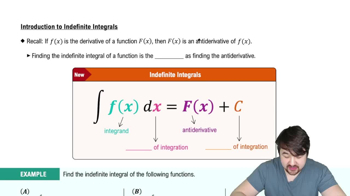
Antiderivative (Indefinite Integral)

An antiderivative of a function f(x) is another function F(x) whose derivative is f(x). It is represented by the indefinite integral ∫f(x) dx = F(x) + C, where C is an arbitrary constant. Understanding this helps verify if a given formula correctly reverses differentiation.
Recommended video:
05:04
Introduction to Indefinite Integrals

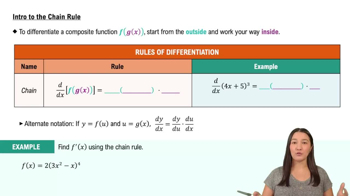
Chain Rule and Its Reverse (Substitution Method)

The chain rule in differentiation handles composite functions. Its reverse, used in integration, often requires substitution to simplify the integral. Recognizing when to apply substitution is key to correctly finding antiderivatives of functions like (2x + 1)².
Recommended video:
05:02
Intro to the Chain Rule

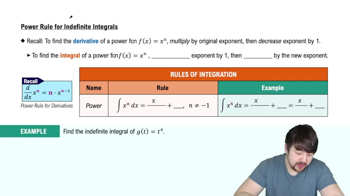
Power Rule for Integration

The power rule states that ∫x^n dx = (x^(n+1))/(n+1) + C for n ≠ -1. When integrating expressions like (2x + 1)², the power rule applies after appropriate substitution, ensuring the integral is computed correctly rather than just raising the inner function to a higher power.
Recommended video:
04:04
Power Rule for Indefinite Integrals