Ch. 10 - Infinite Sequences and Series
Hass - Thomas' Calculus 15th Edition
Hass15th EditionThomas' CalculusISBN: 9780137616077Not the one you use?Change textbook
Chapter 10, Problem 10.9.2

Finding Taylor Series
Use substitution (as in Formula (7)) to find the Taylor series at x = 0 of the functions in Exercises 1–12.
e⁻ˣ/²

Verified step by step guidance
1
Recall the Taylor series expansion of the exponential function \(e^x\) centered at \(x=0\), which is given by: \[e^x = \sum_{n=0}^\infty \frac{x^n}{n!}\]
In the given function, we have \(e^{-x^2}\). To use substitution, let’s replace \(x\) in the exponential series with \(-x^2\). This gives: \[e^{-x^2} = \sum_{n=0}^\infty \frac{(-x^2)^n}{n!}\]
Simplify the powers inside the summation: \[e^{-x^2} = \sum_{n=0}^\infty \frac{(-1)^n x^{2n}}{n!}\]
This series is already centered at \(x=0\), so this is the Taylor series expansion of \(e^{-x^2}\) at \(x=0\).
To write out the first few terms explicitly, substitute \(n=0,1,2,3,\ldots\) into the summation to see the pattern of coefficients and powers of \(x\).

Verified video answer for a similar problem:

This video solution was recommended by our tutors as helpful for the problem above.
Video duration:
3m
Was this helpful?

Key Concepts

Here are the essential concepts you must grasp in order to answer the question correctly.

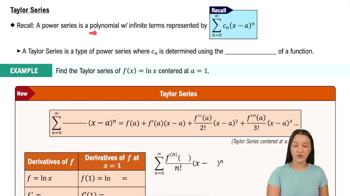
Taylor Series Expansion

A Taylor series represents a function as an infinite sum of terms calculated from the derivatives at a single point, usually around x = 0 (Maclaurin series). It approximates functions using polynomials, making complex functions easier to analyze and compute.
Recommended video:
08:42
Taylor Series

Substitution Method in Series

Substitution involves replacing the variable in a known Taylor series with another expression to find the series of a related function. For example, substituting x² into the series for e^x helps find the series for e^(x²). This method simplifies finding series for composite functions.
Recommended video:
06:00
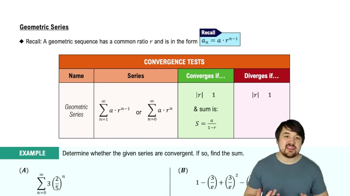
Geometric Series

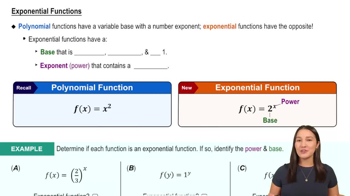
Exponential Function Series

The exponential function e^x has a well-known Taylor series: sum of x^n/n! for n from 0 to infinity. Understanding this base series is essential because many functions, like e^(-x²/2), can be expressed by modifying this series through substitution and algebraic manipulation.
Recommended video:
6:13
Exponential Functions