Ch. 10 - Infinite Sequences and Series
Hass - Thomas' Calculus 15th Edition
Hass15th EditionThomas' CalculusISBN: 9780137616077Not the one you use?Change textbook
Chapter 10, Problem 10.8.25

Finding Taylor and Maclaurin Series
In Exercises 25–34, find the Taylor series generated by f at x = a.
f(x) = x³ − 2x + 4,a = 2

Verified step by step guidance
1
Identify the function and the point about which the Taylor series is generated: here, the function is \(f(x) = x^{3} - 2x + 4\) and the center is \(a = 2\).
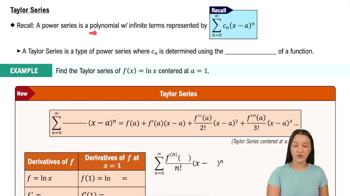
Recall the formula for the Taylor series of a function \(f\) about \(x = a\): \[f(x) = \sum_{n=0}^{\infty} \frac{f^{(n)}(a)}{n!} (x - a)^{n}\] where \(f^{(n)}(a)\) is the \(n\)-th derivative of \(f\) evaluated at \(x = a\).
Compute the derivatives of \(f(x)\) up to the order needed (usually until the derivatives become zero or a pattern emerges): - \(f(x) = x^{3} - 2x + 4\) - \(f'(x) = 3x^{2} - 2\) - \(f''(x) = 6x\) - \(f^{(3)}(x) = 6\) - \(f^{(4)}(x) = 0\) (and all higher derivatives are zero).
Evaluate each derivative at \(x = 2\): - \(f(2) = 2^{3} - 2(2) + 4\) - \(f'(2) = 3(2)^{2} - 2\) - \(f''(2) = 6(2)\) - \(f^{(3)}(2) = 6\) - \(f^{(4)}(2) = 0\).
Write the Taylor series expansion using the formula and the evaluated derivatives: \[f(x) = f(2) + \frac{f'(2)}{1!}(x - 2) + \frac{f''(2)}{2!}(x - 2)^{2} + \frac{f^{(3)}(2)}{3!}(x - 2)^{3} + \cdots\] Since higher derivatives are zero, the series will terminate here.

Verified video answer for a similar problem:

This video solution was recommended by our tutors as helpful for the problem above.
Video duration:
4m
Was this helpful?

Key Concepts

Here are the essential concepts you must grasp in order to answer the question correctly.

Taylor Series

A Taylor series represents a function as an infinite sum of terms calculated from the derivatives of the function at a single point a. It approximates the function near that point using polynomial terms, where each term involves the nth derivative evaluated at a, multiplied by (x - a)^n and divided by n!.
Recommended video:
08:42
Taylor Series

Maclaurin Series

The Maclaurin series is a special case of the Taylor series centered at a = 0. It expresses a function as an infinite sum of derivatives evaluated at zero, useful for approximating functions near zero. Understanding this helps distinguish between general Taylor expansions and those specifically at zero.
Recommended video:
08:26
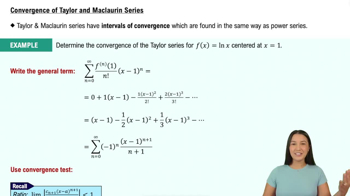
Convergence of Taylor & Maclaurin Series

Derivatives and Their Role in Series Expansion

Derivatives of a function at the point a determine the coefficients of the Taylor series. Calculating successive derivatives and evaluating them at a provides the necessary values to build each term of the series, reflecting the function's behavior near a.
Recommended video:
06:00
Geometric Series