Ch. 10 - Infinite Sequences and Series
Hass - Thomas' Calculus 15th Edition
Hass15th EditionThomas' CalculusISBN: 9780137616077Not the one you use?Change textbook
Chapter 10, Problem 10.8.2

Finding Taylor Polynomials
In Exercises 1–10, find the Taylor polynomials of orders 0, 1, 2, and 3 generated by f at a.
f(x) = sin x,a = 0

Verified step by step guidance
1
Identify the function and the point of expansion: here, the function is \(f(x) = \sin x\) and the Taylor polynomials are centered at \(a = 0\).
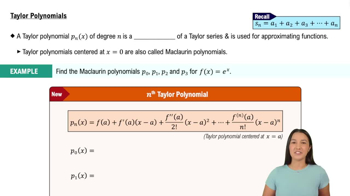
Recall the general formula for the Taylor polynomial of order \(n\) centered at \(a\): \[T_n(x) = \sum_{k=0}^n \frac{f^{(k)}(a)}{k!} (x - a)^k,\] where \(f^{(k)}(a)\) is the \(k\)-th derivative of \(f\) evaluated at \(a\).
Calculate the derivatives of \(f(x) = \sin x\) up to the third order and evaluate each at \(x = 0\): - \(f(x) = \sin x\), - \(f'(x) = \cos x\), - \(f''(x) = -\sin x\), - \(f'''(x) = -\cos x\). Then find \(f(0)\), \(f'(0)\), \(f''(0)\), and \(f'''(0)\).
Write out each Taylor polynomial using the derivatives evaluated at 0: - Order 0: \(T_0(x) = f(0)\), - Order 1: \(T_1(x) = f(0) + f'(0)x\), - Order 2: \(T_2(x) = f(0) + f'(0)x + \frac{f''(0)}{2!}x^2\), - Order 3: \(T_3(x) = f(0) + f'(0)x + \frac{f''(0)}{2!}x^2 + \frac{f'''(0)}{3!}x^3\).
Simplify each polynomial by substituting the values of the derivatives at 0 and factorials, leaving the expressions in terms of powers of \(x\).

Verified video answer for a similar problem:

This video solution was recommended by our tutors as helpful for the problem above.
Video duration:
4m
Was this helpful?

Key Concepts

Here are the essential concepts you must grasp in order to answer the question correctly.

Taylor Polynomials

Taylor polynomials approximate a function near a point a by using a finite sum of its derivatives at a. The nth-order Taylor polynomial includes terms up to the nth derivative, providing increasingly accurate approximations as n grows.
Recommended video:
07:00
Taylor Polynomials

Derivatives of Sine Function

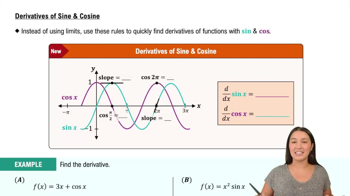
The sine function has a cyclic pattern in its derivatives: f(x) = sin x, f'(x) = cos x, f''(x) = -sin x, f'''(x) = -cos x, and so on. Knowing these derivatives at a specific point is essential for constructing the Taylor polynomial.
Recommended video:
03:53
Derivatives of Sine & Cosine

Evaluating Derivatives at the Expansion Point

To build the Taylor polynomial at a point a, each derivative of the function must be evaluated at a. For a = 0, this means calculating sin(0), cos(0), and their higher derivatives at zero, which simplifies the polynomial coefficients.
Recommended video:
5:14
Evaluate Logarithms