Ch. 10 - Infinite Sequences and Series
Hass - Thomas' Calculus 15th Edition
Hass15th EditionThomas' CalculusISBN: 9780137616077Not the one you use?Change textbook
Chapter 10, Problem 10.6.76

In Exercises 57–82, use any method to determine whether the series converges or diverges. Give reasons for your answer.
∑ (from n = 2 to ∞) [(ln n / n)³]

Verified step by step guidance
1
Identify the given series: \( \sum_{n=2}^{\infty} \left( \frac{\ln n}{n} \right)^3 \). We want to determine if this series converges or diverges.
Recognize that the terms are positive for \( n \geq 2 \), so we can consider convergence tests for series with positive terms.
Consider the Comparison Test or Limit Comparison Test by comparing \( \left( \frac{\ln n}{n} \right)^3 \) to a simpler series. Since \( \ln n \) grows slower than any power of \( n \), compare it to \( \frac{1}{n^p} \) for some \( p \).
Rewrite the term as \( \frac{(\ln n)^3}{n^3} \). Since \( (\ln n)^3 \) grows slower than any power of \( n \), the dominant factor is \( \frac{1}{n^3} \).
Use the p-series test: since \( \sum \frac{1}{n^3} \) converges (because \( p=3 > 1 \)), and \( \left( \frac{\ln n}{n} \right)^3 \) behaves like \( \frac{(\ln n)^3}{n^3} \), the original series converges by the Comparison Test.

Verified video answer for a similar problem:

This video solution was recommended by our tutors as helpful for the problem above.
Video duration:
2m
Was this helpful?

Key Concepts

Here are the essential concepts you must grasp in order to answer the question correctly.

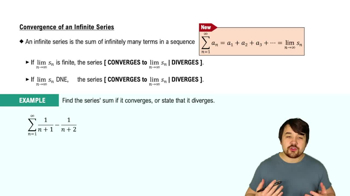
Convergence and Divergence of Series

A series converges if the sum of its terms approaches a finite limit as the number of terms grows indefinitely; otherwise, it diverges. Understanding this helps determine whether the infinite sum has a meaningful value or not.
Recommended video:
06:52
Convergence of an Infinite Series

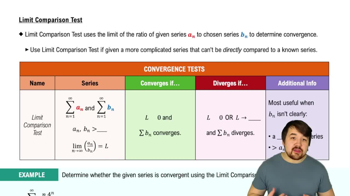
Comparison and Limit Comparison Tests

These tests compare a given series to a known benchmark series to determine convergence or divergence. If terms of the series behave like those of a convergent or divergent series, the original series shares the same behavior.
Recommended video:
07:45
Limit Comparison Test

Behavior of Logarithmic and Polynomial Terms in Series

Analyzing how terms like (ln n)³ and n³ grow helps in assessing the series' terms. Since logarithmic functions grow slower than polynomial functions, this relationship is crucial in applying comparison tests effectively.
Recommended video:
08:42
Taylor Series