Ch. 10 - Infinite Sequences and Series
Hass - Thomas' Calculus 15th Edition
Hass15th EditionThomas' CalculusISBN: 9780137616077Not the one you use?Change textbook
Chapter 10, Problem 10.3.37

Determining Convergence or Divergence
Which of the series in Exercises 13–46 converge, and which diverge? Give reasons for your answers. (When you check an answer, remember that there may be more than one way to determine the series’ convergence or divergence.)
∑ (from n=1 to ∞) eⁿ / (1 + e²ⁿ)

Verified step by step guidance
1
First, write down the general term of the series: \(a_n = \frac{e^n}{1 + e^{2n}}\).
Simplify the term \(a_n\) by factoring the denominator: notice that \(e^{2n} = (e^n)^2\), so rewrite \(a_n\) as \(\frac{e^n}{1 + (e^n)^2}\).
Divide numerator and denominator by \(e^{2n}\) to express \(a_n\) in a form that reveals its behavior as \(n \to \infty\): \(a_n = \frac{e^n / e^{2n}}{(1 / e^{2n}) + 1} = \frac{e^{-n}}{1 + e^{-2n}}\).
Analyze the limit of \(a_n\) as \(n\) approaches infinity: since \(e^{-n} \to 0\) and \(e^{-2n} \to 0\), the term \(a_n\) approaches 0.
To determine convergence, compare \(a_n\) to a known convergent series: since \(a_n\) behaves like \(e^{-n}\) for large \(n\), and the series \(\sum e^{-n}\) is a geometric series with ratio less than 1, use the Comparison Test or Limit Comparison Test to conclude about convergence.

Verified video answer for a similar problem:

This video solution was recommended by our tutors as helpful for the problem above.
Video duration:
2m
Was this helpful?

Key Concepts

Here are the essential concepts you must grasp in order to answer the question correctly.

Infinite Series and Convergence

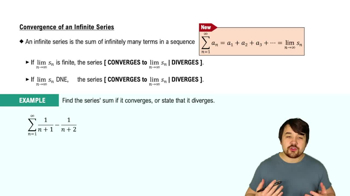
An infinite series is the sum of infinitely many terms. Determining whether a series converges means checking if the sum approaches a finite limit as the number of terms grows indefinitely. If the sum does not approach a finite value, the series diverges.
Recommended video:
06:52
Convergence of an Infinite Series

Comparison Test

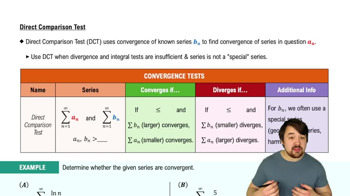
The Comparison Test helps determine convergence by comparing the given series to another series with known behavior. If the terms of the given series are smaller than those of a convergent series, it also converges; if larger than a divergent series, it diverges.
Recommended video:
09:25
Direct Comparison Test

Behavior of Exponential Functions in Series

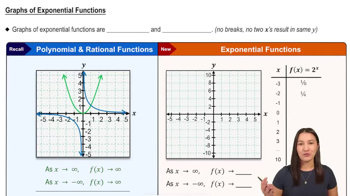
Exponential functions like eⁿ grow rapidly, affecting the terms of a series. Understanding how the numerator and denominator involving exponentials behave as n increases is crucial to analyze the limit of terms and decide convergence or divergence.
Recommended video:
5:46
Graphs of Exponential Functions