Ch. 10 - Infinite Sequences and Series
Hass - Thomas' Calculus 15th Edition
Hass15th EditionThomas' CalculusISBN: 9780137616077Not the one you use?Change textbook
Chapter 10, Problem 10.1.139

Is it true that a sequence {aₙ} of positive numbers must converge if it is bounded above? Give reasons for your answer.

Verified step by step guidance
1
Recall the definition of convergence for a sequence: a sequence \( \{a_n\} \) converges if there exists a limit \( L \) such that for every \( \epsilon > 0 \), there is an \( N \) where for all \( n > N \), \( |a_n - L| < \epsilon \).
Understand that being bounded above means there exists some number \( M \) such that \( a_n \leq M \) for all \( n \), but this does not guarantee the sequence approaches a specific value.
Consider that a sequence can be bounded above but still oscillate or fail to settle down to a single limit, for example, a sequence that jumps between two values less than \( M \).
Note that for convergence, the sequence must get arbitrarily close to one particular number, not just stay below a certain bound.
Conclude that a sequence of positive numbers bounded above does not necessarily converge; boundedness alone is not sufficient to ensure convergence.

Verified video answer for a similar problem:

This video solution was recommended by our tutors as helpful for the problem above.
Video duration:
1m
Was this helpful?

Key Concepts

Here are the essential concepts you must grasp in order to answer the question correctly.

Bounded Sequences

A sequence is bounded above if there exists a number that is greater than or equal to every term in the sequence. Being bounded means the terms do not grow beyond a certain limit, but it does not guarantee convergence by itself.
Recommended video:
Guided course
8:22
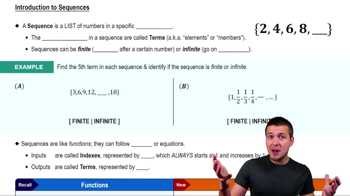
Introduction to Sequences

Convergence of Sequences

A sequence converges if its terms approach a specific finite limit as the index goes to infinity. Convergence requires the terms to get arbitrarily close to a single value, not just to be bounded.
Recommended video:
Guided course
8:22
Introduction to Sequences

Monotone Convergence Theorem

This theorem states that every bounded monotone sequence converges. If a sequence is both bounded and monotone (either non-increasing or non-decreasing), it must converge, but boundedness alone is insufficient.
Recommended video:
07:51
Choosing a Convergence Test