
Ch. 6 - Applications of Integration
Briggs - Calculus: Early Transcendentals 3rd Edition
Briggs3rd EditionCalculus: Early TranscendentalsISBN: 9780136847243Not the one you use?Change textbook
Chapter 6, Problem 6.3.74a

Consider the region R in the first quadrant bounded by y=x^1/n and y=x^n, where n>1 is a positive number.


a. Find the volume V(n) of the solid generated when R is revolved about the x-axis. Express your answer in terms of n.

Verified step by step guidance
1
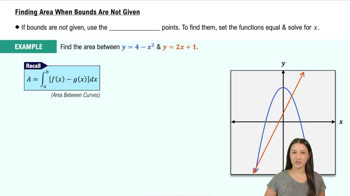
Identify the region R bounded by the curves \(y = x^{\frac{1}{n}}\) and \(y = x^n\) in the first quadrant. Since \(n > 1\), these two curves intersect at \(x=0\) and \(x=1\) because \(x^{\frac{1}{n}} = x^n\) implies \(x=0\) or \(x=1\).
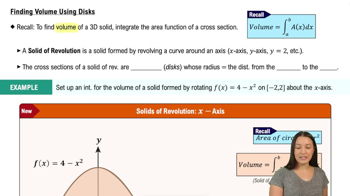
Set up the volume integral using the method of washers (disks with holes) when revolving around the x-axis. The volume \(V(n)\) is given by integrating the difference of the squares of the outer and inner radii:
\[V(n) = \pi \int_0^1 \left[ (\text{outer radius})^2 - (\text{inner radius})^2 \right] \, dx.\]
Determine which curve is the outer radius and which is the inner radius with respect to the x-axis. Since \(y = x^{\frac{1}{n}}\) is greater than \(y = x^n\) on \((0,1)\) for \(n > 1\), the outer radius is \(x^{\frac{1}{n}}\) and the inner radius is \(x^n\).
Write the integral explicitly as: \[V(n) = \pi \int_0^1 \left[ (x^{\frac{1}{n}})^2 - (x^n)^2 \right] \, dx = \pi \int_0^1 \left( x^{\frac{2}{n}} - x^{2n} \right) \, dx.\] Then, integrate term-by-term using the power rule for integrals.

Verified video answer for a similar problem:

This video solution was recommended by our tutors as helpful for the problem above.
Video duration:
8m
Was this helpful?

Key Concepts

Here are the essential concepts you must grasp in order to answer the question correctly.

Defining the Region Bounded by Curves

Understanding the region R requires identifying the curves y = x^(1/n) and y = x^n and their intersection points in the first quadrant. Since n > 1, these functions define a closed area between them for x in [0,1]. Recognizing the limits of integration is essential for setting up the volume integral.
Recommended video:
05:06
Finding Area When Bounds Are Not Given

Volume of Solids of Revolution Using the Disk/Washer Method

When a region is revolved about the x-axis, the volume can be found by integrating the area of circular cross-sections perpendicular to the axis. The washer method applies when there is an inner and outer radius, calculated from the bounding curves, and the volume is the integral of π(outer radius² - inner radius²) dx over the interval.
Recommended video:
04:48
Finding Volume Using Disks

Integration of Power Functions

The volume integral involves integrating expressions like x^(2/n) and x^(2n), which are power functions. Applying the power rule for integration, ∫x^m dx = x^(m+1)/(m+1), is necessary to find a closed-form expression for V(n) in terms of n.
Recommended video:
07:32
Representing Functions as Power Series
Related Practice
Textbook Question

Winding a chain A 30-m-long chain hangs vertically from a cylinder attached to a winch. Assume there is no friction in the system and the chain has a density of 5kg/m.

a. How much work is required to wind the entire chain onto the cylinder using the winch?

Textbook Question

Emptying a cylindrical tank A cylindrical water tank has height 8 m and radius 2m (see figure).

a. If the tank is full of water, how much work is required to pump the water to the level of the top of the tank and out of the tank?

Textbook Question

Blood flow A typical human heart pumps 70 mL of blood (the stroke volume) with each beat. Assuming a heart rate of 60 beats/min (1 beat/s), a reasonable model for the outflow rate of the heart is V′(t)=70(1+sin 2πt), where V(t) is the amount of blood (in milliliters) pumped over the interval [0,t],V(0)=0 and t is measured in seconds.


a. Verify that the amount of blood pumped over a one-second interval is 70 mL.

Textbook Question

21–30. {Use of Tech} Arc length by calculator


a. Write and simplify the integral that gives the arc length of the following curves on the given interval. 

y = x³/3, for −1≤x≤1

Textbook Question

Given the velocity function of an object moving along a line, explain how definite integrals can be used to find the displacement of the object.

Textbook Question

6–8. Let R be the region bounded by the curves y = 2−√x,y=2, and x=4 in the first quadrant.


Suppose the shell method is used to determine the volume of the solid generated by revolving R about the line x=4.


a. What is the radius of a cylindrical shell at a point x in [0, 4]?