
Ch. 6 - Applications of Integration
Briggs - Calculus: Early Transcendentals 3rd Edition
Briggs3rd EditionCalculus: Early TranscendentalsISBN: 9780136847243Not the one you use?Change textbook
Chapter 6, Problem 6.7.31a

Winding a chain A 30-m-long chain hangs vertically from a cylinder attached to a winch. Assume there is no friction in the system and the chain has a density of 5kg/m.
a. How much work is required to wind the entire chain onto the cylinder using the winch?

Verified step by step guidance
1
Identify the physical quantities involved: the length of the chain \(L = 30\) m, the linear density \(\rho = 5\) kg/m, and gravitational acceleration \(g = 9.8\) m/s² (assuming standard gravity).
Express the mass of a small segment of the chain of length \(dx\) at a distance \(x\) from the bottom as \(dm = \rho \\ dx\), where \(x\) measures the length of chain lifted from the bottom upwards.
Determine the work required to lift this small segment \(dm\) by a height \(x\) (since the chain is being wound up from the bottom, each segment must be lifted a distance equal to its position \(x\)). The infinitesimal work is \(dW = (dm)(g)(x) = \rho g x \\ dx\).
Set up the integral for the total work by integrating \(dW\) over the entire length of the chain from \(x=0\) (bottom) to \(x=L=30\) m: \(W = \int_0^{30} \rho g x \\ dx\).
Evaluate the integral to find the total work done in winding the entire chain onto the cylinder.

Verified video answer for a similar problem:

This video solution was recommended by our tutors as helpful for the problem above.
Video duration:
5m
Was this helpful?

Key Concepts

Here are the essential concepts you must grasp in order to answer the question correctly.

Work Done by a Variable Force

Work is the integral of force over distance. When the force varies with position, such as lifting different parts of a chain, we calculate work by integrating the force function over the displacement. This approach accounts for the changing weight as the chain is wound up.
Recommended video:
05:40
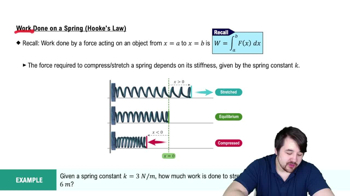
Work Done On A Spring (Hooke's Law)

Linear Density and Weight Calculation

Linear density is the mass per unit length of an object, here given as 5 kg/m. Multiplying linear density by gravitational acceleration and length gives the weight of a segment of the chain. This helps determine the force needed to lift varying lengths of the chain.
Recommended video:
07:17
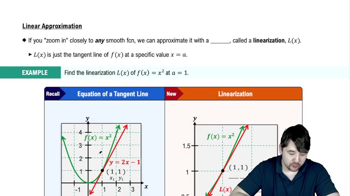
Linearization

Setting up and Evaluating Definite Integrals

To find total work, we set up a definite integral representing the sum of infinitesimal work elements over the chain's length. Each element corresponds to lifting a small segment of the chain a certain distance. Evaluating this integral yields the total work required.
Recommended video:
05:43
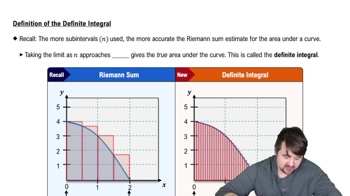
Definition of the Definite Integral
Related Practice
Textbook Question

40–43. Population growth


A culture of bacteria in a Petri dish has an initial population of 1500 cells and grows at a rate (in cells/day) of N′(t) = 100e^−0.25t. Assume t is measured in days.


a. What is the population after 20 days? After 40 days?

Textbook Question

Find the area of the region (see figure) in two ways.

a. Using integration with respect to x.

Textbook Question

Emptying a cylindrical tank A cylindrical water tank has height 8 m and radius 2m (see figure).

a. If the tank is full of water, how much work is required to pump the water to the level of the top of the tank and out of the tank?

Textbook Question

Blood flow A typical human heart pumps 70 mL of blood (the stroke volume) with each beat. Assuming a heart rate of 60 beats/min (1 beat/s), a reasonable model for the outflow rate of the heart is V′(t)=70(1+sin 2πt), where V(t) is the amount of blood (in milliliters) pumped over the interval [0,t],V(0)=0 and t is measured in seconds.


a. Verify that the amount of blood pumped over a one-second interval is 70 mL.

Textbook Question

Consider the region R in the first quadrant bounded by y=x^1/n and y=x^n, where n>1 is a positive number.


a. Find the volume V(n) of the solid generated when R is revolved about the x-axis. Express your answer in terms of n.

1
views
Textbook Question

6–8. Let R be the region bounded by the curves y = 2−√x,y=2, and x=4 in the first quadrant.


Suppose the shell method is used to determine the volume of the solid generated by revolving R about the line x=4.


a. What is the radius of a cylindrical shell at a point x in [0, 4]?