
Ch. 6 - Applications of Integration
Briggs - Calculus: Early Transcendentals 3rd Edition
Briggs3rd EditionCalculus: Early TranscendentalsISBN: 9780136847243Not the one you use?Change textbook
Chapter 6, Problem 6.1.50a

Blood flow A typical human heart pumps 70 mL of blood (the stroke volume) with each beat. Assuming a heart rate of 60 beats/min (1 beat/s), a reasonable model for the outflow rate of the heart is V′(t)=70(1+sin 2πt), where V(t) is the amount of blood (in milliliters) pumped over the interval [0,t],V(0)=0 and t is measured in seconds.


a. Verify that the amount of blood pumped over a one-second interval is 70 mL.

Verified step by step guidance
1
Understand that the function \(V'(t) = 70(1 + \sin 2\pi t)\) represents the rate of blood flow in milliliters per second at time \(t\), and \(V(t)\) is the total volume pumped from time 0 to time \(t\).
To find the total amount of blood pumped over the interval from \(t=0\) to \(t=1\) second, we need to integrate the rate function \(V'(t)\) over this interval. This means calculating \(V(1) - V(0) = \int_0^1 V'(t) \, dt\).
Set up the integral: \(\int_0^1 70(1 + \sin 2\pi t) \, dt\). This integral can be split into two parts: \(70 \int_0^1 1 \, dt + 70 \int_0^1 \sin 2\pi t \, dt\).
Evaluate each integral separately: the first integral \(\int_0^1 1 \, dt\) is straightforward, and the second integral \(\int_0^1 \sin 2\pi t \, dt\) involves the sine function with a frequency of \(2\pi\).
Add the results of the two integrals and multiply by 70 to find the total volume pumped over one second. This value should verify that the amount of blood pumped in one second is 70 mL.

Verified video answer for a similar problem:

This video solution was recommended by our tutors as helpful for the problem above.
Video duration:
3m
Was this helpful?

Key Concepts

Here are the essential concepts you must grasp in order to answer the question correctly.

Derivative as Rate of Change

The derivative of a function represents the instantaneous rate of change of the quantity with respect to time. In this problem, V′(t) models the rate at which blood volume is pumped at time t, allowing us to understand how the volume changes moment by moment.
Recommended video:
04:16
Intro To Related Rates

Definite Integral and Accumulated Quantity

The definite integral of a rate function over an interval gives the total accumulated amount over that time. Here, integrating V′(t) from 0 to 1 second yields the total blood volume pumped in that interval, which should match the stroke volume.
Recommended video:
05:43
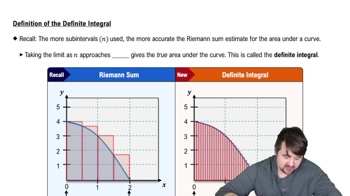
Definition of the Definite Integral

Properties of the Sine Function in Modeling

The sine function models periodic behavior, such as the heartbeat. Its integral over one full period is zero, which helps simplify calculations by isolating the constant term in V′(t), confirming the average flow rate corresponds to the stroke volume.
Recommended video:
06:21
Properties of Functions