
Ch. 6 - Applications of Integration
Briggs - Calculus: Early Transcendentals 3rd Edition
Briggs3rd EditionCalculus: Early TranscendentalsISBN: 9780136847243Not the one you use?Change textbook
Chapter 6, Problem 6.5.24a

21–30. {Use of Tech} Arc length by calculator


a. Write and simplify the integral that gives the arc length of the following curves on the given interval. 
y = x³/3, for −1≤x≤1

Verified step by step guidance
1
Recall the formula for the arc length of a curve defined by a function \( y = f(x) \) on the interval \( [a, b] \): \[ L = \int_a^b \sqrt{1 + \left(\frac{dy}{dx}\right)^2} \, dx \]
Identify the function and the interval: here, \( y = \frac{x^3}{3} \) and \( x \) ranges from \( -1 \) to \( 1 \).
Compute the derivative \( \frac{dy}{dx} \) of the function: \[ \frac{dy}{dx} = \frac{d}{dx} \left( \frac{x^3}{3} \right) = x^2 \]
Substitute \( \frac{dy}{dx} = x^2 \) into the arc length formula to get the integral: \[ L = \int_{-1}^1 \sqrt{1 + (x^2)^2} \, dx = \int_{-1}^1 \sqrt{1 + x^4} \, dx \]
This integral expression represents the arc length of the curve on the given interval. It can be evaluated using a calculator or numerical methods since it does not have a simple antiderivative.

Verified video answer for a similar problem:

This video solution was recommended by our tutors as helpful for the problem above.
Video duration:
1m
Was this helpful?

Key Concepts

Here are the essential concepts you must grasp in order to answer the question correctly.

Arc Length Formula

The arc length of a curve y = f(x) from x = a to x = b is given by the integral ∫ from a to b of √(1 + (dy/dx)²) dx. This formula calculates the length of the curve by summing infinitesimal line segments along the curve.
Recommended video:
06:29
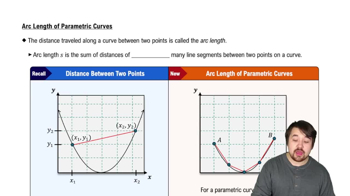
Arc Length of Parametric Curves

Derivative of the Function

To apply the arc length formula, you need the derivative dy/dx of the function y = x³/3. Differentiating gives dy/dx = x², which is then squared inside the integral to find the integrand √(1 + (dy/dx)²).
Recommended video:
06:30
Derivatives of Other Trig Functions

Setting up and Simplifying the Integral

After finding dy/dx, substitute it into the arc length integral and simplify the expression under the square root. For y = x³/3, the integral becomes ∫ from -1 to 1 of √(1 + x⁴) dx, which may require numerical methods or a calculator for evaluation.
Recommended video:
08:12
Integration by Parts for Definite Integrals Example 7
Related Practice
Textbook Question

Work in a gravitational field For large distances from the surface of Earth, the gravitational force is given by F(x) = GMm / (x+R)², where G = 6.7×10^−11 N m²/kg² is the gravitational constant, M = 6×10^24 kg is the mass of Earth, m is the mass of the object in the gravitational field, R = 6.378×10⁶ m is the radius of Earth, and x≥0 is the distance above the surface of Earth (in meters).


a. How much work is required to launch a rocket with a mass of 500 kg in a vertical flight path to a height of 2500 km (from Earth’s surface)?

1
views
Textbook Question

55–58. Marginal cost Consider the following marginal cost functions.


a. Find the additional cost incurred in dollars when production is increased from 100 units to 150 units.


C′(x) = 300+10x−0.01x²

Textbook Question

Emptying a cylindrical tank A cylindrical water tank has height 8 m and radius 2m (see figure).

a. If the tank is full of water, how much work is required to pump the water to the level of the top of the tank and out of the tank?

Textbook Question

Consider the region R in the first quadrant bounded by y=x^1/n and y=x^n, where n>1 is a positive number.


a. Find the volume V(n) of the solid generated when R is revolved about the x-axis. Express your answer in terms of n.

1
views
Textbook Question

Given the velocity function of an object moving along a line, explain how definite integrals can be used to find the displacement of the object.

Textbook Question

6–8. Let R be the region bounded by the curves y = 2−√x,y=2, and x=4 in the first quadrant.


Suppose the shell method is used to determine the volume of the solid generated by revolving R about the line x=4.


a. What is the radius of a cylindrical shell at a point x in [0, 4]?