
Textbook Question
55–58. Marginal cost Consider the following marginal cost functions.
a. Find the additional cost incurred in dollars when production is increased from 100 units to 150 units.
C′(x) = 300+10x−0.01x²

 Verified step by step guidance
 09:32
09:32
 05:40
05:40 06:11
06:1155–58. Marginal cost Consider the following marginal cost functions.
a. Find the additional cost incurred in dollars when production is increased from 100 units to 150 units.
C′(x) = 300+10x−0.01x²
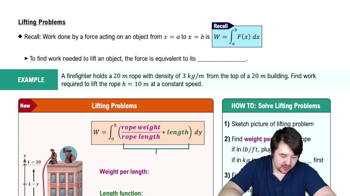
Emptying a cylindrical tank A cylindrical water tank has height 8 m and radius 2m (see figure).
a. If the tank is full of water, how much work is required to pump the water to the level of the top of the tank and out of the tank?
Functions from arc length What differentiable functions have an arc length on the interval [a, b] given by the following integrals? Note that the answers are not unique. Give a family of functions that satisfy the conditions.
a. ∫a^b √1+16x⁴ dx
21–30. {Use of Tech} Arc length by calculator
a. Write and simplify the integral that gives the arc length of the following curves on the given interval.
y = x³/3, for −1≤x≤1
Given the velocity function of an object moving along a line, explain how definite integrals can be used to find the displacement of the object.
Depletion of natural resources Suppose r(t) = r0e^−kt, with k>0, is the rate at which a nation extracts oil, where r0=10⁷ barrels/yr is the current rate of extraction. Suppose also that the estimate of the total oil reserve is 2×10⁹ barrels.
a. Find Q(t), the total amount of oil extracted by the nation after t years.