Ch 39: Wave Functions and Uncertainty
Knight Calc - Physics for Scientists and Engineers 5th Edition
Knight Calc5th EditionPhysics for Scientists and EngineersISBN: 9780137344796Not the one you use?Change textbook
Chapter 39, Problem 31b

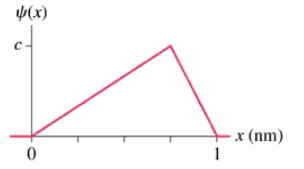
FIGURE P39.31 shows the wave function of a particle confined between x = 0 nm and x = 1.0 nm. The wave function is zero outside this region. Draw a graph of the probability density P(x)=|ψ(x)|2

Verified step by step guidance
1
Understand the problem: The wave function ψ(x) represents the quantum state of a particle confined between x = 0 nm and x = 1.0 nm. The probability density P(x) is given by P(x) = |ψ(x)|², which represents the likelihood of finding the particle at a specific position x within the region. Outside this region, ψ(x) = 0, so P(x) = 0.
Step 1: Analyze the given wave function ψ(x). Carefully examine the shape of ψ(x) as shown in FIGURE P39.31. Identify any key features such as peaks, nodes (where ψ(x) = 0), and symmetry. These features will influence the shape of P(x).
Step 2: Compute the probability density P(x). For each value of x within the region (0 nm ≤ x ≤ 1.0 nm), calculate P(x) = |ψ(x)|². This involves squaring the magnitude of ψ(x) at each point. If ψ(x) is complex, take the modulus squared: |ψ(x)|² = ψ(x)ψ*(x), where ψ*(x) is the complex conjugate of ψ(x).
Step 3: Plot the graph of P(x). Use the calculated values of P(x) to create a graph. The x-axis represents the position (x), and the y-axis represents the probability density P(x). Ensure the graph reflects the squared nature of ψ(x), meaning peaks in ψ(x) will correspond to peaks in P(x), and nodes in ψ(x) will correspond to zeros in P(x).
Step 4: Interpret the graph. The graph of P(x) should show where the particle is most likely to be found within the region. Areas with higher values of P(x) indicate higher probabilities, while areas with P(x) = 0 indicate no likelihood of finding the particle there. Confirm that P(x) = 0 outside the region (x < 0 nm and x > 1.0 nm).

Key Concepts

Here are the essential concepts you must grasp in order to answer the question correctly.

Wave Function (ψ)

The wave function, denoted as ψ(x), is a fundamental concept in quantum mechanics that describes the quantum state of a particle. It contains all the information about the particle's position and momentum. The wave function can take on complex values, and its square modulus, |ψ(x)|^2, represents the probability density of finding the particle at a specific position x.
Recommended video:
Guided course
08:30
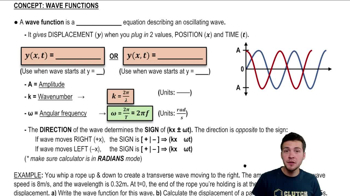
Intro to Wave Functions

Probability Density

Probability density, represented as P(x) = |ψ(x)|^2, quantifies the likelihood of locating a particle within a given region of space. It is derived from the wave function and is always non-negative. The integral of the probability density over a specific interval gives the probability of finding the particle in that interval, ensuring that the total probability across the entire space equals one.
Recommended video:
Guided course
8:13
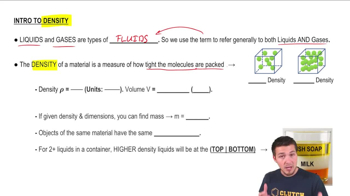
Intro to Density

Normalization of the Wave Function

Normalization is a crucial process in quantum mechanics that ensures the total probability of finding a particle in all space equals one. For a wave function to be physically meaningful, it must be normalized, which involves adjusting the wave function so that the integral of the probability density over the entire space equals one. This ensures that the wave function accurately reflects the probabilities of the particle's position.
Recommended video:
Guided course
08:30
Intro to Wave Functions
Related Practice
Textbook Question

FIGURE P39.31 shows the wave function of a particle confined between x = 0 nm and x = 1.0 nm. The wave function is zero outside this region. Calculate the probability of finding the particle in the interval 0 nm ≤ x ≤ 0.25 nm.

Textbook Question

FIGURE P39.31 shows the wave function of a particle confined between x = 0 nm and x = 1.0 nm. The wave function is zero outside this region. Determine the value of the constant c, as defined in the figure.

40
views
Textbook Question

Consider the electron wave function ψ(x)={c1x2x1 cm0x1 cm\(\psi\) (x)=\(\begin{cases}\) c\(\sqrt{1-x^{2}\)} & \(\left\)|x\(\right\)|\(\leq\) 1\(\text{ cm}\) \\ 0 & \(\left\)|x\(\right\)|\(\geq\) 1\(\text{ cm}\) \(\end{cases}\) where x is in cm. Draw a graph of ψ(x) over the interval −2 cm ≤ x ≤ 2 cm. Provide numerical scales on both axes.

Textbook Question

An experiment finds electrons to be uniformly distributed over the interval 0 cm ≤ x ≤ 2 cm, with no electrons falling outside this interval. If 106 electrons are detected, how many will be detected in the interval 0.79 to 0.81 cm?

1
views
Textbook Question

Consider the electron wave function ψ(x)={c1x2x1 cm0x1 cm\(\psi\) (x)=\(\begin{cases}\) c\(\sqrt{1-x^{2}\)} & \(\left\)|x\(\right\)|\(\leq\) 1\(\text{ cm}\) \\ 0 & \(\left\)|x\(\right\)|\(\geq\) 1\(\text{ cm}\) \(\end{cases}\) where x is in cm. Determine the normalization constant c.

Textbook Question

An experiment finds electrons to be uniformly distributed over the interval 0 cm ≤ x ≤ 2 cm, with no electrons falling outside this interval. What is the probability density at x = 0.80 cm?

2
views