Ch 39: Wave Functions and Uncertainty
Knight Calc - Physics for Scientists and Engineers 5th Edition
Knight Calc5th EditionPhysics for Scientists and EngineersISBN: 9780137344796Not the one you use?Change textbook
Chapter 39, Problem 31a

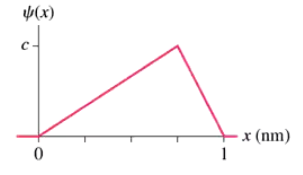
FIGURE P39.31 shows the wave function of a particle confined between x = 0 nm and x = 1.0 nm. The wave function is zero outside this region. Determine the value of the constant c, as defined in the figure.

Verified step by step guidance
1
Step 1: Recognize that the wave function ψ(x) must satisfy the normalization condition for a particle confined in a region. This means the integral of |ψ(x)|² over the region from x = 0 nm to x = 1.0 nm must equal 1.
Step 2: Analyze the given wave function. The graph shows a triangular shape, with ψ(x) increasing linearly from 0 at x = 0 to a maximum value of c at x = 0.5 nm, and then decreasing linearly back to 0 at x = 1.0 nm.
Step 3: Write the mathematical expression for ψ(x). For 0 ≤ x ≤ 0.5 nm, ψ(x) = (2c)x, and for 0.5 ≤ x ≤ 1.0 nm, ψ(x) = 2c(1 - x). These expressions are derived from the slopes of the lines in the graph.
Step 4: Set up the normalization integral: ∫[0 to 1] |ψ(x)|² dx = 1. Split the integral into two parts: ∫[0 to 0.5] (2c)²x² dx + ∫[0.5 to 1] (2c)²(1 - x)² dx = 1.
Step 5: Solve the integrals separately. For the first integral, calculate ∫[0 to 0.5] (4c²)x² dx, and for the second integral, calculate ∫[0.5 to 1] (4c²)(1 - x)² dx. Combine the results, simplify, and solve for c to ensure the normalization condition is satisfied.

Key Concepts

Here are the essential concepts you must grasp in order to answer the question correctly.

Wave Function

The wave function, denoted as ψ(x), describes the quantum state of a particle in a given region. It contains all the information about the particle's position and momentum. The square of the wave function's magnitude, |ψ(x)|², gives the probability density of finding the particle at a specific position, which is crucial for understanding quantum mechanics.
Recommended video:
Guided course
08:30
Intro to Wave Functions

Normalization Condition

In quantum mechanics, the normalization condition requires that the total probability of finding a particle within a defined region equals one. This is mathematically expressed as the integral of |ψ(x)|² over the region of interest being equal to one. For the wave function in the given problem, this condition will help determine the constant c by ensuring the area under the curve of |ψ(x)|² from 0 to 1 nm equals one.
Recommended video:
Guided course
08:17
The Normal Force

Boundary Conditions

Boundary conditions are constraints that the wave function must satisfy at the edges of the defined region. In this case, the wave function is zero outside the interval from 0 nm to 1 nm, indicating that the particle cannot be found outside this region. These conditions are essential for solving quantum problems, as they help define the behavior of the wave function at the limits of the system.
Recommended video:
Guided course
03:59
More Rollercoaster Problems
Related Practice