
Ch 39: Wave Functions and Uncertainty
Knight Calc - Physics for Scientists and Engineers 5th Edition
Knight Calc5th EditionPhysics for Scientists and EngineersISBN: 9780137344796Not the one you use?Change textbook
Chapter 39, Problem 30c

An experiment finds electrons to be uniformly distributed over the interval 0 cm ≤ x ≤ 2 cm, with no electrons falling outside this interval. If 106 electrons are detected, how many will be detected in the interval 0.79 to 0.81 cm?

Verified step by step guidance
1
Step 1: Understand the problem. The electrons are uniformly distributed over the interval 0 cm ≤ x ≤ 2 cm, meaning the probability density function is constant across this interval. The total number of electrons detected is 10^6, and we need to calculate how many electrons are detected in the subinterval 0.79 cm to 0.81 cm.
Step 2: Calculate the probability density. Since the distribution is uniform, the probability density function (PDF) is given by dividing the total number of electrons by the length of the interval. The length of the interval is 2 cm - 0 cm = 2 cm. Therefore, the PDF is \( \frac{10^6}{2} \) electrons per cm.
Step 3: Determine the length of the subinterval. The subinterval is from 0.79 cm to 0.81 cm, so its length is \( 0.81 - 0.79 = 0.02 \) cm.
Step 4: Calculate the number of electrons in the subinterval. Multiply the probability density by the length of the subinterval: \( \text{Number of electrons} = \text{PDF} \times \text{Length of subinterval} = \frac{10^6}{2} \times 0.02 \).
Step 5: Simplify the expression to find the number of electrons in the subinterval. This step involves performing the multiplication, but the final numerical result is not calculated here as per the instructions.

Verified video answer for a similar problem:

This video solution was recommended by our tutors as helpful for the problem above.
Was this helpful?

Key Concepts

Here are the essential concepts you must grasp in order to answer the question correctly.

Uniform Distribution

Uniform distribution refers to a probability distribution where all outcomes are equally likely. In this context, the electrons are uniformly distributed over the specified interval, meaning that the probability of finding an electron in any sub-interval is proportional to the length of that sub-interval relative to the total length of the interval.
Recommended video:
Guided course
04:03
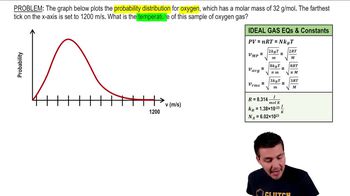
Probability Distribution Graph

Probability Density

Probability density describes how probability is distributed over a continuous range of values. For uniformly distributed electrons, the probability density can be calculated by dividing the total number of electrons by the length of the interval. This density allows us to determine the expected number of electrons in any smaller interval within the larger range.
Recommended video:
Guided course
8:13
Intro to Density

Calculating Expected Counts

To find the expected number of electrons in a specific interval, we multiply the probability density by the length of that interval. In this case, the length of the interval from 0.79 cm to 0.81 cm is 0.02 cm. By applying the uniform distribution principles, we can calculate how many of the total 10^6 electrons are likely to be found in this small segment.
Recommended video:
Guided course
04:44
Counting Significant Figures
Related Practice
Textbook Question

FIGURE P39.28 shows a pulse train. The period of the pulse train is T = 2 Δt, where Δt is the duration of each pulse. What is the maximum pulse-transmission rate (pulses per second) through an electronics system with a 200 kHz bandwidth? (This is the bandwidth allotted to each FM radio station.)

Textbook Question

A 1.0-mm-diameter sphere bounces back and forth between two walls at x = 0 mm and x = 100 mm. The collisions are perfectly elastic, and the sphere repeats this motion over and over with no loss of speed. At a random instant of time, what is the probability that the center of the sphere is between x = 49.0 mm and x = 51.0 mm?

1
views
Textbook Question

FIGURE P39.31 shows the wave function of a particle confined between x = 0 nm and x = 1.0 nm. The wave function is zero outside this region. Determine the value of the constant c, as defined in the figure.

40
views
Textbook Question

Consider a single-slit diffraction experiment using electrons. (Single-slit diffraction was described in Section 33.4.) Using Figure 39.5 as a model, draw A graph of |ψ(x)|2 for the electrons on the detection screen.

Textbook Question

FIGURE P39.31 shows the wave function of a particle confined between x = 0 nm and x = 1.0 nm. The wave function is zero outside this region. Draw a graph of the probability density P(x)=|ψ(x)|2

Textbook Question

An experiment finds electrons to be uniformly distributed over the interval 0 cm ≤ x ≤ 2 cm, with no electrons falling outside this interval. What is the probability density at x = 0.80 cm?

2
views