
Ch 39: Wave Functions and Uncertainty
Knight Calc - Physics for Scientists and Engineers 5th Edition
Knight Calc5th EditionPhysics for Scientists and EngineersISBN: 9780137344796Not the one you use?Change textbook
Chapter 39, Problem 28

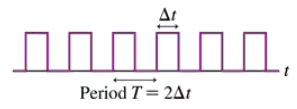
FIGURE P39.28 shows a pulse train. The period of the pulse train is T = 2 Δt, where Δt is the duration of each pulse. What is the maximum pulse-transmission rate (pulses per second) through an electronics system with a 200 kHz bandwidth? (This is the bandwidth allotted to each FM radio station.)

Verified step by step guidance
1
Step 1: Understand the relationship between the pulse train period and the pulse duration. The period of the pulse train is given as T = 2Δt, where Δt is the duration of each pulse. This means that the time between the start of one pulse and the start of the next pulse is twice the duration of a single pulse.
Step 2: Recall the concept of bandwidth and its relationship to pulse transmission rate. Bandwidth is the range of frequencies that a system can handle, and it determines the maximum rate at which pulses can be transmitted. The pulse transmission rate is inversely proportional to the period T of the pulse train.
Step 3: Calculate the pulse transmission rate using the formula: Pulse Transmission Rate = 1 / T. Since T = 2Δt, substitute this into the formula to get Pulse Transmission Rate = 1 / (2Δt).
Step 4: Relate the pulse transmission rate to the bandwidth of the system. The maximum pulse transmission rate is limited by the bandwidth of the system, which is given as 200 kHz. This means the pulse transmission rate cannot exceed 200,000 pulses per second.
Step 5: Combine the information to determine the maximum pulse transmission rate. Ensure that the calculated pulse transmission rate (1 / (2Δt)) does not exceed the bandwidth limit of 200 kHz. If Δt is small enough, the system can achieve the maximum rate of 200,000 pulses per second.

Verified video answer for a similar problem:

This video solution was recommended by our tutors as helpful for the problem above.
Was this helpful?

Key Concepts

Here are the essential concepts you must grasp in order to answer the question correctly.

Pulse Train

A pulse train is a sequence of pulses that occur at regular intervals. Each pulse has a specific duration, denoted as Δt, and the time between the start of one pulse and the start of the next is called the period (T). In this case, the period is defined as T = 2Δt, indicating that the pulse duration is half of the total time between pulses.
Recommended video:

Bandwidth

Bandwidth refers to the range of frequencies that a system can transmit or process. In the context of the question, a bandwidth of 200 kHz indicates the maximum frequency range available for transmitting signals. This bandwidth limits the number of pulses that can be transmitted per second, as higher frequencies allow for more rapid signal changes.

Pulse Transmission Rate

The pulse transmission rate is the number of pulses that can be sent through a system in one second, measured in pulses per second (Hz). To calculate this rate, one can use the formula: transmission rate = 1/T, where T is the period of the pulse train. Given the bandwidth, the maximum transmission rate is constrained by the available frequency range, allowing for efficient signal processing.
Recommended video:
Guided course
6:34
Fluid Speed & Volume Flow Rate
Related Practice
Textbook Question

A 1.0-mm-diameter sphere bounces back and forth between two walls at x = 0 mm and x = 100 mm. The collisions are perfectly elastic, and the sphere repeats this motion over and over with no loss of speed. At a random instant of time, what is the probability that the center of the sphere is between x = 49.0 mm and x = 51.0 mm?

1
views
Textbook Question

Consider a single-slit diffraction experiment using electrons. (Single-slit diffraction was described in Section 33.4.) Using Figure 39.5 as a model, draw A graph of |ψ(x)|2 for the electrons on the detection screen.

Textbook Question

An experiment finds electrons to be uniformly distributed over the interval 0 cm ≤ x ≤ 2 cm, with no electrons falling outside this interval. If 106 electrons are detected, how many will be detected in the interval 0.79 to 0.81 cm?

1
views
Textbook Question

A 1.0-mm-diameter sphere bounces back and forth between two walls at x = 0 mm and x = 100 mm. The collisions are perfectly elastic, and the sphere repeats this motion over and over with no loss of speed. At a random instant of time, what is the probability that the center of the sphere is at exactly x = 50.0 mm?

1
views
Textbook Question

An experiment finds electrons to be uniformly distributed over the interval 0 cm ≤ x ≤ 2 cm, with no electrons falling outside this interval. What is the probability density at x = 0.80 cm?

2
views
Textbook Question

What is the minimum uncertainty in position, in nm, of an electron whose velocity is known to be between 3×10⁵ m/s and 4 ×10⁵ m/s? Give your answer to one significant figure.