
Ch 39: Wave Functions and Uncertainty
Knight Calc - Physics for Scientists and Engineers 5th Edition
Knight Calc5th EditionPhysics for Scientists and EngineersISBN: 9780137344796Not the one you use?Change textbook
Chapter 39, Problem 30d

An experiment finds electrons to be uniformly distributed over the interval 0 cm ≤ x ≤ 2 cm, with no electrons falling outside this interval. What is the probability density at x = 0.80 cm?

Verified step by step guidance
1
Understand the concept of probability density: In this problem, the electrons are uniformly distributed over the interval 0 cm ≤ x ≤ 2 cm. This means the probability density function (PDF) is constant across this interval. The total probability over the interval must equal 1.
Determine the formula for the probability density: For a uniform distribution, the probability density \( \rho(x) \) is given by \( \rho(x) = \frac{1}{b - a} \), where \( a \) and \( b \) are the bounds of the interval. Here, \( a = 0 \) cm and \( b = 2 \) cm.
Substitute the values of \( a \) and \( b \) into the formula: \( \rho(x) = \frac{1}{2 - 0} = \frac{1}{2} \) cm\(^{-1}\). This is the constant probability density across the interval.
Evaluate the probability density at \( x = 0.80 \) cm: Since the distribution is uniform, the probability density is the same at all points within the interval. Thus, \( \rho(0.80) = \frac{1}{2} \) cm\(^{-1}\).
Conclude that the probability density at \( x = 0.80 \) cm is \( \frac{1}{2} \) cm\(^{-1}\), as it is constant across the interval.

Verified video answer for a similar problem:

This video solution was recommended by our tutors as helpful for the problem above.
Was this helpful?

Key Concepts

Here are the essential concepts you must grasp in order to answer the question correctly.

Probability Density

Probability density is a statistical measure that describes the likelihood of a random variable falling within a particular range of values. In quantum mechanics, it is often used to represent the distribution of particles, such as electrons, over a given space. The probability density function must integrate to one over the entire space to ensure that the total probability is conserved.
Recommended video:
Guided course
8:13
Intro to Density

Uniform Distribution

A uniform distribution is a type of probability distribution in which all outcomes are equally likely within a specified range. For the given interval of 0 cm to 2 cm, this means that the probability density is constant across this range. The uniform distribution simplifies calculations, as the probability density can be determined by dividing the total probability by the length of the interval.
Recommended video:
Guided course
04:03
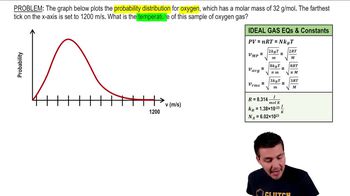
Probability Distribution Graph

Normalization

Normalization is the process of adjusting the probability density function so that the total probability over the defined interval equals one. For a uniform distribution over the interval from 0 cm to 2 cm, the normalization constant can be calculated by ensuring that the area under the probability density curve equals one. This is crucial for accurately interpreting the probability of finding a particle at a specific location.
Recommended video:
Guided course
08:17
The Normal Force
Related Practice