Ch 39: Wave Functions and Uncertainty
Knight Calc - Physics for Scientists and Engineers 5th Edition
Knight Calc5th EditionPhysics for Scientists and EngineersISBN: 9780137344796Not the one you use?Change textbook
Chapter 39, Problem 36a

Consider the electron wave function ψ(x)={c1x2x1 cm0x1 cm\(\psi\) (x)=\(\begin{cases}\) c\(\sqrt{1-x^{2}\)} & \(\left\)|x\(\right\)|\(\leq\) 1\(\text{ cm}\) \\ 0 & \(\left\)|x\(\right\)|\(\geq\) 1\(\text{ cm}\) \(\end{cases}\) where x is in cm. Determine the normalization constant c.

Verified step by step guidance
1
Step 1: Understand the concept of normalization. The wave function ψ(x) must satisfy the normalization condition, which states that the total probability of finding the particle in all space must equal 1. Mathematically, this is expressed as ∫|ψ(x)|² dx = 1, where the integral is taken over the entire domain of x.
Step 2: Identify the domain of the wave function. The given wave function ψ(x) is nonzero only for |x| ≤ 1 cm. Outside this range (|x| ≥ 1 cm), ψ(x) = 0. Therefore, the integral for normalization will only be evaluated over the interval [-1 cm, 1 cm].
Step 3: Substitute the given wave function into the normalization condition. For |x| ≤ 1 cm, ψ(x) = √c(1 − x²). The normalization condition becomes: ∫[-1, 1] |ψ(x)|² dx = 1. Substituting ψ(x), this becomes ∫[-1, 1] c(1 − x²)² dx = 1.
Step 4: Expand the integrand (1 − x²)² to simplify the integral. Expanding gives (1 − x²)² = 1 − 2x² + x⁴. The integral now becomes ∫[-1, 1] c(1 − 2x² + x⁴) dx = 1.
Step 5: Evaluate the integral term by term. Break the integral into separate terms: ∫[-1, 1] c dx − ∫[-1, 1] 2cx² dx + ∫[-1, 1] cx⁴ dx. Use symmetry properties of the integrals: ∫[-1, 1] x² dx and ∫[-1, 1] x⁴ dx are symmetric, while ∫[-1, 1] dx is straightforward. Solve these integrals to find the value of c that satisfies the normalization condition.

Verified video answer for a similar problem:

This video solution was recommended by our tutors as helpful for the problem above.
Was this helpful?

Key Concepts

Here are the essential concepts you must grasp in order to answer the question correctly.

Wave Function

In quantum mechanics, a wave function describes the quantum state of a particle, encapsulating information about its position and momentum. The square of the absolute value of the wave function gives the probability density of finding the particle in a particular state. In this case, the wave function ψ(x) is defined piecewise, indicating the behavior of the electron within a specified range.
Recommended video:
Guided course
08:30
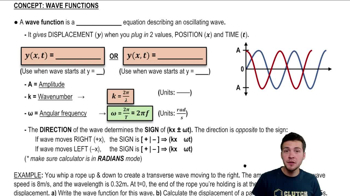
Intro to Wave Functions

Normalization

Normalization is a crucial process in quantum mechanics that ensures the total probability of finding a particle in all possible states equals one. For a wave function to be normalized, the integral of the probability density over the entire space must equal one. This involves calculating the normalization constant, c, which adjusts the wave function so that the area under the probability density curve is unity.
Recommended video:
Guided course
08:17
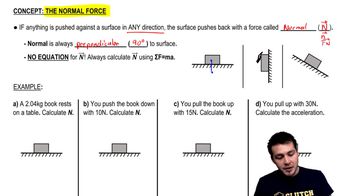
The Normal Force

Integral Calculus

Integral calculus is a branch of mathematics that deals with the accumulation of quantities, such as areas under curves. In the context of normalizing a wave function, it is used to compute the integral of the square of the wave function over its defined range. This mathematical tool is essential for determining the normalization constant by ensuring that the total probability is correctly calculated.
Recommended video:
Guided course
11:43
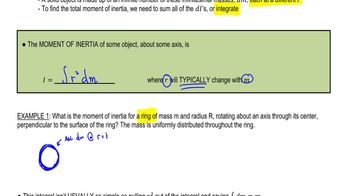
Finding Moment Of Inertia By Integrating
Related Practice
Textbook Question

Consider the electron wave function ψ(x)={c1x2x1 cm0x1 cm\(\psi\) (x)=\(\begin{cases}\) c\(\sqrt{1-x^{2}\)} & \(\left\)|x\(\right\)|\(\leq\) 1\(\text{ cm}\) \\ 0 & \(\left\)|x\(\right\)|\(\geq\) 1\(\text{ cm}\) \(\end{cases}\) where x is in cm. Draw a graph of |ψ(x)|2 over the interval −2 cm ≤ x ≤ 2 cm. Provide numerical scales.

Textbook Question

FIGURE P39.31 shows the wave function of a particle confined between x = 0 nm and x = 1.0 nm. The wave function is zero outside this region. Calculate the probability of finding the particle in the interval 0 nm ≤ x ≤ 0.25 nm.

Textbook Question

FIGURE P39.31 shows the wave function of a particle confined between x = 0 nm and x = 1.0 nm. The wave function is zero outside this region. Determine the value of the constant c, as defined in the figure.

40
views
Textbook Question

A particle is described by the wave function ψ(x)={cex/Lx0 mmcex/Lx0 mm\(\psi\) (x)=\(\begin{cases}\) ce^{x/L} & x\(\leq\) 0\(\text{ mm}\) \\ ce^{-x/L} & x\(\geq\) 0\(\text{ mm}\) \(\end{cases}\) where L = 2.0 mm. Sketch graphs of both the wave function and the probability density as functions of x.

Textbook Question

FIGURE P39.31 shows the wave function of a particle confined between x = 0 nm and x = 1.0 nm. The wave function is zero outside this region. Draw a graph of the probability density P(x)=|ψ(x)|2

Textbook Question

Consider the electron wave function ψ(x)={c1x2x1 cm0x1 cm\(\psi\) (x)=\(\begin{cases}\) c\(\sqrt{1-x^{2}\)} & \(\left\)|x\(\right\)|\(\leq\) 1\(\text{ cm}\) \\ 0 & \(\left\)|x\(\right\)|\(\geq\) 1\(\text{ cm}\) \(\end{cases}\) where x is in cm. Draw a graph of ψ(x) over the interval −2 cm ≤ x ≤ 2 cm. Provide numerical scales on both axes.