
Ch 29: The Magnetic Field
Knight Calc - Physics for Scientists and Engineers 5th Edition
Knight Calc5th EditionPhysics for Scientists and EngineersISBN: 9780137344796Not the one you use?Change textbook
Chapter 29, Problem 29

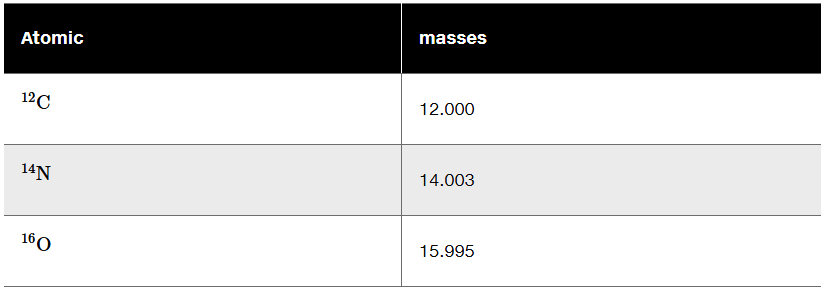
To five significant figures, what are the cyclotron frequencies in a 3.0000 T magnetic field of the ions (a) O₂⁺, (b) N₂⁺, and (c) CO⁺? The atomic masses are shown in the table; the mass of the missing electron is less than 0.001 u and is not relevant at this level of precision. Although N₂⁺ and CO⁺ both have a nominal molecular mass of 28, they are easily distinguished by virtue of their slightly different cyclotron frequencies. Use the following constants: 1 u = 1.6605 x 10⁻²⁷ kg, e = 1.6022 x 10⁻¹⁹ C.

Verified step by step guidance
1
Step 1: Understand the cyclotron frequency formula. The cyclotron frequency (f) is given by the formula: f=qmB, where q is the charge of the ion, m is the mass of the ion, and B is the magnetic field strength.
Step 2: Determine the charge of the ions. Since the ions are singly charged (O₂⁺, N₂⁺, CO⁺), the charge q is equal to the elementary charge, e=1.6022×10⁻¹⁹C.
Step 3: Calculate the mass of each ion in kilograms. Use the atomic masses provided in the table and the conversion factor 1u=1.6605×10⁻²⁷kg. For O₂⁺, the mass is 2×15.995×1.6605×10-27. Similarly, calculate for N₂⁺ and CO⁺ using their respective atomic masses.
Step 4: Substitute the values into the cyclotron frequency formula. For each ion, substitute q = 1.6022×10⁻¹⁹, m (calculated in Step 3), and B = 3.0000T into the formula f=qmB.
Step 5: Compare the cyclotron frequencies of N₂⁺ and CO⁺. Note that although both have a nominal molecular mass of 28 u, their slightly different atomic masses will result in distinct cyclotron frequencies, allowing them to be distinguished.

Verified video answer for a similar problem:

This video solution was recommended by our tutors as helpful for the problem above.
Was this helpful?

Key Concepts

Here are the essential concepts you must grasp in order to answer the question correctly.

Cyclotron Frequency

Cyclotron frequency is the frequency at which a charged particle orbits in a magnetic field. It is determined by the charge of the particle, the strength of the magnetic field, and the mass of the particle. The formula for cyclotron frequency (f) is f = (qB)/(2πm), where q is the charge, B is the magnetic field strength, and m is the mass of the particle. This concept is crucial for understanding the motion of ions in magnetic fields.
Recommended video:
Guided course
05:08
Circumference, Period, and Frequency in UCM

Atomic Mass Unit (u)

The atomic mass unit (u) is a standard unit of mass used to express atomic and molecular weights. One atomic mass unit is defined as one twelfth of the mass of a carbon-12 atom, approximately 1.6605 x 10⁻²⁷ kg. In this context, the atomic masses of ions like O₂⁺, N₂⁺, and CO⁺ are essential for calculating their cyclotron frequencies, as the mass directly influences the frequency of their motion in a magnetic field.
Recommended video:
Guided course
18:29
Pressure Gauges: U-Shaped Tube

Magnetic Field Strength

Magnetic field strength, denoted as B, is a measure of the intensity of a magnetic field at a given point in space. It is typically measured in teslas (T). In this problem, a magnetic field strength of 3.0000 T is provided, which is necessary for calculating the cyclotron frequencies of the ions. The strength of the magnetic field affects the radius and frequency of the charged particles' circular motion.
Recommended video:
Guided course
05:30
Magnetic Fields and Magnetic Dipoles