
Ch 29: The Magnetic Field
Knight Calc - Physics for Scientists and Engineers 5th Edition
Knight Calc5th EditionPhysics for Scientists and EngineersISBN: 9780137344796Not the one you use?Change textbook
Chapter 29, Problem 31a

The microwaves in a microwave oven are produced in a special tube called a magnetron. The electrons orbit the magnetic field at 2.4 GHz, and as they do so they emit 2.4 GHz electromagnetic waves. What is the magnetic field strength?

Verified step by step guidance
1
Understand the relationship between the frequency of the electron's motion and the magnetic field strength. The frequency of the electron's circular motion in a magnetic field is given by the cyclotron frequency formula: f = qmB, where f is the frequency, q is the charge of the electron, m is the mass of the electron, and B is the magnetic field strength.
Rearrange the formula to solve for the magnetic field strength B: B = fmq. This step isolates B in terms of the known quantities.
Substitute the known values into the formula. The frequency f is given as 2.4 GHz, which is equivalent to 2.4 × 10⁹ Hz. The charge of the electron q is 1.6 × 10⁻¹⁹ C, and the mass of the electron m is 9.11 × 10⁻³¹ kg.
Perform unit conversions if necessary. Ensure that all quantities are in SI units (e.g., Hz for frequency, C for charge, kg for mass). This step ensures consistency in the calculation.
Plug the values into the rearranged formula and simplify. The magnetic field strength B can now be calculated using the substituted values. This step completes the setup for solving the problem.

Verified video answer for a similar problem:

This video solution was recommended by our tutors as helpful for the problem above.
Was this helpful?

Key Concepts

Here are the essential concepts you must grasp in order to answer the question correctly.

Electromagnetic Waves

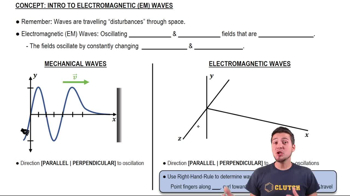
Electromagnetic waves are oscillations of electric and magnetic fields that propagate through space. They encompass a wide range of frequencies, including microwaves, which have wavelengths between 1 mm and 1 m. The frequency of these waves, measured in hertz (Hz), determines their energy and behavior, with higher frequencies corresponding to higher energy.
Recommended video:
Guided course
05:22
Introduction to Electromagnetic (EM) Waves

Magnetron

A magnetron is a type of vacuum tube that generates microwaves using the interaction of a magnetic field with electrons. In a magnetron, electrons are emitted from a heated cathode and are influenced by a magnetic field, causing them to spiral and produce microwave radiation at a specific frequency, such as 2.4 GHz in microwave ovens.

Magnetic Field Strength

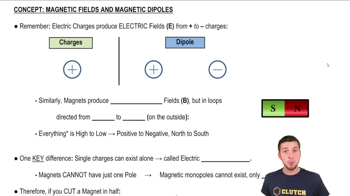
Magnetic field strength, often denoted as B, is a measure of the intensity of a magnetic field at a given point in space. It is typically measured in teslas (T) or gauss (G). The strength of the magnetic field is crucial in determining the behavior of charged particles, such as electrons in a magnetron, and can be calculated using various formulas depending on the context, including the relationship between frequency and magnetic field in electromagnetic theory.
Recommended video:
Guided course
05:30
Magnetic Fields and Magnetic Dipoles
Related Practice
Textbook Question

Radio astronomers detect electromagnetic radiation at 45 MHz from an interstellar gas cloud. They suspect this radiation is emitted by electrons spiraling in a magnetic field. What is the magnetic field strength inside the gas cloud?

1
views
Textbook Question

To five significant figures, what are the cyclotron frequencies in a 3.0000 T magnetic field of the ions (a) O₂⁺, (b) N₂⁺, and (c) CO⁺? The atomic masses are shown in the table; the mass of the missing electron is less than 0.001 u and is not relevant at this level of precision. Although N₂⁺ and CO⁺ both have a nominal molecular mass of 28, they are easily distinguished by virtue of their slightly different cyclotron frequencies. Use the following constants: 1 u = 1.6605 x 10⁻²⁷ kg, e = 1.6022 x 10⁻¹⁹ C.

1
views
Textbook Question

The two 10-cm-long parallel wires in FIGURE EX29.33 are separated by 5.0 mm. For what value of the resistor R will the force between the two wires be 5.4 x 10⁻⁵ N?

3
views
Textbook Question

A proton moves in the magnetic field B = 0.50 î T with a speed of 1.0 x 10⁷ m/s in the directions shown in FIGURE EX29.27. For each, what is magnetic force F on the proton? Give your answers in component form.

1
views
Textbook Question

FIGURE EX29.37 is a cross section through three long wires with linear mass density 50 g/m. They each carry equal currents in the directions shown. The lower two wires are 4.0 cm apart and are attached to a table. What current I will allow the upper wire to 'float' so as to form an equilateral triangle with the lower wires?

2
views
Textbook Question

The Hall voltage across a conductor in a 55 mT magnetic field is 1.9 μV. When used with the same current in a different magnetic field, the voltage across the conductor is 2.8 μV. What is the strength of the second field?

1
views