Ch 29: The Magnetic Field
Knight Calc - Physics for Scientists and Engineers 5th Edition
Knight Calc5th EditionPhysics for Scientists and EngineersISBN: 9780137344796Not the one you use?Change textbook
Chapter 29, Problem 33

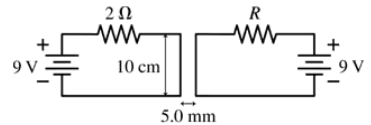
The two 10-cm-long parallel wires in FIGURE EX29.33 are separated by 5.0 mm. For what value of the resistor R will the force between the two wires be 5.4 x 10⁻⁵ N?

Verified step by step guidance
1
Step 1: Understand the problem. The force between two parallel current-carrying wires is given by the formula: F = rac{{\(\text{μ₀}\) imes I₁ imes I₂ imes L}}{{2\(\text{π}\) imes d}}, where F is the force, μ₀ is the permeability of free space (4\(\text{π}\) imes 10^{-7} \(\text{ T·m/A}\)), I₁ and I₂ are the currents in the wires, L is the length of the wires, and d is the distance between the wires.
Step 2: Rearrange the formula to solve for the product of currents I₁ × I₂. Using the given values, substitute F = 5.4 × 10⁻⁵ N, L = 0.10 m, and d = 0.005 m into the formula: I₁ imes I₂ = rac{{F imes 2\(\text{π}\) imes d}}{{\(\text{μ₀}\) imes L}}.
Step 3: Recognize that the current I₁ in one wire is determined by the circuit containing the resistor R. Use Ohm's Law, I₁ = rac{{V}}{{R}}, where V is the voltage across the resistor R. Substitute this expression for I₁ into the formula for I₁ × I₂.
Step 4: Assume the second wire carries the same current as the first wire (I₂ = I₁). Substitute I₂ = I₁ into the formula for I₁ × I₂, resulting in I₁^2 = rac{{F imes 2\(\text{π}\) imes d}}{{\(\text{μ₀}\) imes L}}. Solve for I₁ by taking the square root: I₁ = \(\text{√}\) rac{{F imes 2\(\text{π}\) imes d}}{{\(\text{μ₀}\) imes L}}.
Step 5: Substitute the expression for I₁ from Step 4 into Ohm's Law to find R: R = rac{{V}}{{I₁}}. Use the calculated value of I₁ and the given voltage V to determine the resistor value R.

Verified video answer for a similar problem:

This video solution was recommended by our tutors as helpful for the problem above.
Video duration:
6m
Was this helpful?

Key Concepts

Here are the essential concepts you must grasp in order to answer the question correctly.

Magnetic Force Between Parallel Wires

The magnetic force between two parallel wires carrying current is given by the formula F = (μ₀/2π) * (I₁ * I₂ * L) / d, where F is the force, μ₀ is the permeability of free space, I₁ and I₂ are the currents in the wires, L is the length of the wires, and d is the distance between them. This relationship shows how the force depends on the currents and their separation.
Recommended video:
Guided course
10:11
Magnetic Force Between Parallel Currents

Ohm's Law

Ohm's Law states that the current (I) flowing through a conductor between two points is directly proportional to the voltage (V) across the two points and inversely proportional to the resistance (R) of the conductor. It is mathematically expressed as V = I * R, which is essential for determining the current in the wires when a voltage is applied.
Recommended video:
Guided course
03:07
Resistance and Ohm's Law

Resistor in a Circuit

A resistor is a component in an electrical circuit that resists the flow of electric current, causing a voltage drop. The value of the resistor affects the current flowing through the circuit according to Ohm's Law. In this problem, finding the appropriate resistor value R is crucial to achieve the desired force between the wires by controlling the current.
Recommended video:
Guided course
03:12
Resistors in AC Circuits
Related Practice
Textbook Question

What is the loop's equilibrium orientation?

2
views

Textbook Question

To five significant figures, what are the cyclotron frequencies in a 3.0000 T magnetic field of the ions (a) O₂⁺, (b) N₂⁺, and (c) CO⁺? The atomic masses are shown in the table; the mass of the missing electron is less than 0.001 u and is not relevant at this level of precision. Although N₂⁺ and CO⁺ both have a nominal molecular mass of 28, they are easily distinguished by virtue of their slightly different cyclotron frequencies. Use the following constants: 1 u = 1.6605 x 10⁻²⁷ kg, e = 1.6022 x 10⁻¹⁹ C.

1
views
Textbook Question

What is the magnitude of the torque on the current loop in FIGURE EX29.39?

1
views
Textbook Question

FIGURE EX29.37 is a cross section through three long wires with linear mass density 50 g/m. They each carry equal currents in the directions shown. The lower two wires are 4.0 cm apart and are attached to a table. What current I will allow the upper wire to 'float' so as to form an equilateral triangle with the lower wires?

2
views
Textbook Question

The microwaves in a microwave oven are produced in a special tube called a magnetron. The electrons orbit the magnetic field at 2.4 GHz, and as they do so they emit 2.4 GHz electromagnetic waves. What is the magnetic field strength?

1
views
Textbook Question

The Hall voltage across a conductor in a 55 mT magnetic field is 1.9 μV. When used with the same current in a different magnetic field, the voltage across the conductor is 2.8 μV. What is the strength of the second field?

1
views