Ch 29: The Magnetic Field
Knight Calc - Physics for Scientists and Engineers 5th Edition
Knight Calc5th EditionPhysics for Scientists and EngineersISBN: 9780137344796Not the one you use?Change textbook
Chapter 29, Problem 27

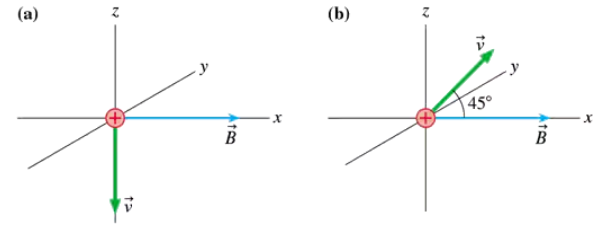
A proton moves in the magnetic field B = 0.50 î T with a speed of 1.0 x 10⁷ m/s in the directions shown in FIGURE EX29.27. For each, what is magnetic force F on the proton? Give your answers in component form.

Verified step by step guidance
1
Step 1: Recall the formula for the magnetic force on a charged particle: \( \mathbf{F} = q \mathbf{v} \times \mathbf{B} \), where \( q \) is the charge of the particle, \( \mathbf{v} \) is the velocity vector, and \( \mathbf{B} \) is the magnetic field vector. For a proton, \( q = +1.6 \times 10^{-19} \, \mathrm{C} \).
Step 2: For part (a), the velocity vector \( \mathbf{v} \) is directed along the negative \( z \)-axis (\( \mathbf{v} = -v \hat{z} \)), and the magnetic field vector \( \mathbf{B} \) is directed along the positive \( x \)-axis (\( \mathbf{B} = B \hat{x} \)). Use the cross product \( \mathbf{v} \times \mathbf{B} \) to find the direction and components of \( \mathbf{F} \).
Step 3: Compute the cross product for part (a): \( \mathbf{v} \times \mathbf{B} = (-v \hat{z}) \times (B \hat{x}) \). Using the right-hand rule, the result is \( \mathbf{F} = q v B \hat{y} \), where \( \hat{y} \) is the positive \( y \)-direction.
Step 4: For part (b), the velocity vector \( \mathbf{v} \) makes a 45° angle with the positive \( y \)-axis in the \( y \)-\( z \) plane. Decompose \( \mathbf{v} \) into components: \( \mathbf{v} = v \cos(45°) \hat{y} + v \sin(45°) \hat{z} \). The magnetic field vector remains \( \mathbf{B} = B \hat{x} \).
Step 5: Compute the cross product for part (b): \( \mathbf{v} \times \mathbf{B} = (v \cos(45°) \hat{y} + v \sin(45°) \hat{z}) \times (B \hat{x}) \). Using the distributive property and the right-hand rule, calculate the components of \( \mathbf{F} \) in the \( y \)- and \( z \)-directions. The final force vector will be expressed in component form.

Verified video answer for a similar problem:

This video solution was recommended by our tutors as helpful for the problem above.
Was this helpful?

Key Concepts

Here are the essential concepts you must grasp in order to answer the question correctly.

Magnetic Force on a Charged Particle

The magnetic force acting on a charged particle, such as a proton, moving in a magnetic field is given by the Lorentz force equation: F = q(v × B). Here, F is the magnetic force, q is the charge of the particle, v is its velocity vector, and B is the magnetic field vector. The direction of the force is determined by the right-hand rule, which states that if you point your thumb in the direction of the velocity and your fingers in the direction of the magnetic field, your palm will face the direction of the force.
Recommended video:
Guided course
09:08
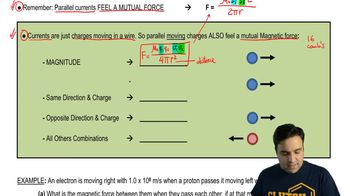
Magnetic Force Between Two Moving Charges

Cross Product

The cross product is a mathematical operation that takes two vectors and produces a third vector that is perpendicular to the plane formed by the original vectors. In the context of the magnetic force, the cross product v × B determines the direction of the force on the charged particle. The magnitude of the cross product is given by |v||B|sin(θ), where θ is the angle between the two vectors, which is crucial for calculating the force when the velocity is not perpendicular to the magnetic field.
Recommended video:
Guided course
10:30
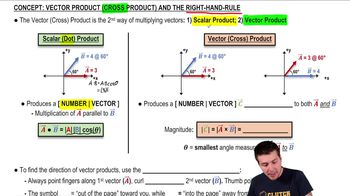
Vector (Cross) Product and the Right-Hand-Rule

Component Form of Vectors

Vectors can be expressed in component form, which breaks them down into their respective components along the coordinate axes. For example, a vector in three-dimensional space can be represented as F = (Fx, Fy, Fz), where Fx, Fy, and Fz are the components along the x, y, and z axes, respectively. This representation is essential for solving problems involving forces in different directions, allowing for easier calculations and clearer understanding of the vector's influence in each dimension.

Recommended video:
Guided course
07:30
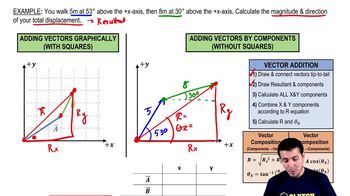
Vector Addition By Components
Related Practice
Textbook Question

Radio astronomers detect electromagnetic radiation at 45 MHz from an interstellar gas cloud. They suspect this radiation is emitted by electrons spiraling in a magnetic field. What is the magnetic field strength inside the gas cloud?

1
views
Textbook Question

What is the line integral of Bds\(\overrightarrow{B}\[\cdot\]\overrightarrow{ds}\) between points i and f in FIGURE EX29.19?

1
views
Textbook Question

The on-axis magnetic field strength 10 cm from a small bar magnet is 500 μT. What is the on-axis field strength 15 cm from the magnet?

1
views
Textbook Question

To five significant figures, what are the cyclotron frequencies in a 3.0000 T magnetic field of the ions (a) O₂⁺, (b) N₂⁺, and (c) CO⁺? The atomic masses are shown in the table; the mass of the missing electron is less than 0.001 u and is not relevant at this level of precision. Although N₂⁺ and CO⁺ both have a nominal molecular mass of 28, they are easily distinguished by virtue of their slightly different cyclotron frequencies. Use the following constants: 1 u = 1.6605 x 10⁻²⁷ kg, e = 1.6022 x 10⁻¹⁹ C.

1
views
Textbook Question

The value of the line integral of Bds\(\overrightarrow{B}\[\cdot\]\overrightarrow{ds}\) around the closed path in FIGURE EX29.21 is 1.38 x 10⁻⁵ T m. What are the direction (into or out of the figure) and magnitude of I3?

2
views
Textbook Question

The microwaves in a microwave oven are produced in a special tube called a magnetron. The electrons orbit the magnetic field at 2.4 GHz, and as they do so they emit 2.4 GHz electromagnetic waves. What is the magnetic field strength?

1
views