

Ch 29: The Magnetic Field
Knight Calc - Physics for Scientists and Engineers 5th Edition
Knight Calc5th EditionPhysics for Scientists and EngineersISBN: 9780137344796Not the one you use?Change textbook
Chapter 29, Problem 21

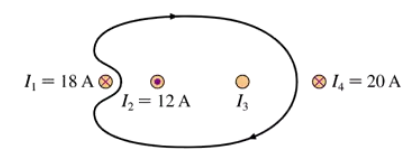
The value of the line integral of Bds\(\overrightarrow{B}\[\cdot\]\overrightarrow{ds}\) around the closed path in FIGURE EX29.21 is 1.38 x 10⁻⁵ T m. What are the direction (into or out of the figure) and magnitude of I3?

Verified step by step guidance
1
Step 1: Recall Ampere's Law, which states that the line integral of the magnetic field around a closed path is proportional to the net current enclosed by the path. The formula is: Bds=μoI, where μo is the permeability of free space and I is the net current enclosed.
Step 2: Substitute the given value of the line integral into Ampere's Law. The line integral is given as 1.38×10⁻⁵Tm. The permeability of free space is a constant: μo=4×10⁻⁷Tm/A.
Step 3: Rearrange Ampere's Law to solve for the net current enclosed, I. The formula becomes: I=Bdsμo. Substitute the values for the line integral and μo into this equation.
Step 4: Determine the direction of the current I3. Use the right-hand rule: if the magnetic field circulates counterclockwise around the closed path, the current is directed out of the figure. If the field circulates clockwise, the current is directed into the figure.
Step 5: Calculate the magnitude of I3 using the rearranged formula from Step 3. Ensure the units are consistent and verify the direction using the right-hand rule.

Verified video answer for a similar problem:

This video solution was recommended by our tutors as helpful for the problem above.
Video duration:
5m
Was this helpful?

Key Concepts

Here are the essential concepts you must grasp in order to answer the question correctly.

Line Integral of Magnetic Field

The line integral of a magnetic field (→B) along a closed path quantifies the total magnetic influence along that path. It is mathematically represented as ∮ →B ⋅ ds, where ds is an infinitesimal vector element of the path. This integral is crucial in applications of Ampère's Law, which relates the magnetic field around a closed loop to the electric current passing through the loop.
Recommended video:
Guided course
08:20
Electric Field Lines

Ampère's Law

Ampère's Law states that the line integral of the magnetic field around a closed loop is proportional to the total current passing through the loop. Mathematically, it is expressed as ∮ →B ⋅ ds = μ₀I_enc, where I_enc is the enclosed current and μ₀ is the permeability of free space. This law is fundamental in electromagnetism, allowing us to relate magnetic fields to currents.
Recommended video:

Direction of Current

The direction of current (I₃ in this case) can be determined using the right-hand rule, which states that if you curl the fingers of your right hand in the direction of the magnetic field lines, your thumb points in the direction of the current. Understanding the relationship between current direction and magnetic field orientation is essential for solving problems involving magnetic fields and currents, especially in closed loops.
Recommended video:
09:49
Direction of Current in Loop Equations
Related Practice
Textbook Question

Radio astronomers detect electromagnetic radiation at 45 MHz from an interstellar gas cloud. They suspect this radiation is emitted by electrons spiraling in a magnetic field. What is the magnetic field strength inside the gas cloud?

1
views
Textbook Question

What is the line integral of Bds\(\overrightarrow{B}\[\cdot\]\overrightarrow{ds}\) between points i and f in FIGURE EX29.19?

1
views
Textbook Question

The on-axis magnetic field strength 10 cm from a small bar magnet is 500 μT. What is the on-axis field strength 15 cm from the magnet?

1
views
Textbook Question

To five significant figures, what are the cyclotron frequencies in a 3.0000 T magnetic field of the ions (a) O₂⁺, (b) N₂⁺, and (c) CO⁺? The atomic masses are shown in the table; the mass of the missing electron is less than 0.001 u and is not relevant at this level of precision. Although N₂⁺ and CO⁺ both have a nominal molecular mass of 28, they are easily distinguished by virtue of their slightly different cyclotron frequencies. Use the following constants: 1 u = 1.6605 x 10⁻²⁷ kg, e = 1.6022 x 10⁻¹⁹ C.

1
views
Textbook Question

A proton moves in the magnetic field B = 0.50 î T with a speed of 1.0 x 10⁷ m/s in the directions shown in FIGURE EX29.27. For each, what is magnetic force F on the proton? Give your answers in component form.

1
views
Textbook Question

A 100 A current circulates around a 2.0-mm-diameter superconducting ring. What is the on-axis magnetic field strength 5.0 cm from the ring?

1
views