Ch 29: The Magnetic Field
Knight Calc - Physics for Scientists and Engineers 5th Edition
Knight Calc5th EditionPhysics for Scientists and EngineersISBN: 9780137344796Not the one you use?Change textbook
Chapter 29, Problem 16b

A 100 A current circulates around a 2.0-mm-diameter superconducting ring. What is the on-axis magnetic field strength 5.0 cm from the ring?

Verified step by step guidance
1
Determine the radius of the superconducting ring. Since the diameter is given as 2.0 mm, the radius \( r \) is half of the diameter: \( r = \frac{2.0 \text{ mm}}{2} = 1.0 \text{ mm} = 1.0 \times 10^{-3} \text{ m} \).
Use the Biot-Savart law to calculate the magnetic field on the axis of a current loop. The formula for the magnetic field at a point along the axis of a circular current loop is: \( B = \frac{\mu_0 I r^2}{2 (r^2 + z^2)^{3/2}} \), where \( \mu_0 \) is the permeability of free space (\( 4\pi \times 10^{-7} \ \text{T·m/A} \)), \( I \) is the current, \( r \) is the radius of the loop, and \( z \) is the distance from the center of the loop along the axis.
Substitute the known values into the formula: \( I = 100 \ \text{A} \), \( r = 1.0 \times 10^{-3} \ \text{m} \), and \( z = 5.0 \ \text{cm} = 0.05 \ \text{m} \).
Simplify the expression for \( B \) by calculating the terms \( r^2 \), \( z^2 \), and \( (r^2 + z^2)^{3/2} \). Then multiply by the constants \( \mu_0 \), \( I \), and \( r^2 \) as per the formula.
After simplifying, the result will give the magnetic field strength \( B \) at a distance of 5.0 cm from the ring along its axis.

Verified video answer for a similar problem:

This video solution was recommended by our tutors as helpful for the problem above.
Was this helpful?

Key Concepts

Here are the essential concepts you must grasp in order to answer the question correctly.

Superconductivity

Superconductivity is a phenomenon where certain materials exhibit zero electrical resistance and expel magnetic fields when cooled below a critical temperature. In superconductors, electric current can flow indefinitely without energy loss, making them ideal for applications like magnetic levitation and powerful electromagnets.

Magnetic Field of a Current Loop

The magnetic field generated by a current-carrying loop can be calculated using the Biot-Savart law or Ampère's law. For a circular loop, the magnetic field strength at a point along the axis can be determined by considering the contributions from each segment of the loop, which combine to create a net magnetic field.
Recommended video:
Guided course
13:54
Magnetic Field Produced by Loops and Solenoids

Biot-Savart Law

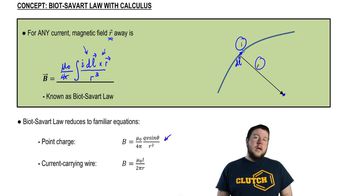
The Biot-Savart law describes how electric currents produce magnetic fields. It states that the magnetic field dB at a point in space due to a small segment of current-carrying wire is directly proportional to the current and inversely proportional to the square of the distance from the wire segment to the point, factoring in the angle between the current direction and the line connecting the wire to the point.
Recommended video:
Guided course
04:53
Biot-Savart Law with Calculus