Ch 29: The Magnetic Field
Knight Calc - Physics for Scientists and Engineers 5th Edition
Knight Calc5th EditionPhysics for Scientists and EngineersISBN: 9780137344796Not the one you use?Change textbook
Chapter 29, Problem 13

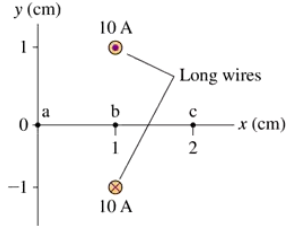
What are the magnetic fields at points a to c in FIGURE EX29.13? Give your answers as vectors.

Verified step by step guidance
1
Step 1: Identify the configuration of the wires and the points where the magnetic field needs to be calculated. The figure shows two long wires carrying currents of 10 A each. One wire has current flowing out of the page (denoted by a dot), and the other has current flowing into the page (denoted by a cross). Points a, b, and c are located along the x-axis at distances 0 cm, 1 cm, and 2 cm respectively.
Step 2: Use the Biot-Savart law or Ampere's law to determine the magnetic field produced by a long straight wire at a given point. The magnetic field due to a long straight wire is given by the formula: B=μ0I2πr, where μ0 is the permeability of free space, I is the current, and r is the distance from the wire.
Step 3: Determine the direction of the magnetic field at each point using the right-hand rule. For the wire with current coming out of the page, curl the fingers of your right hand around the wire with your thumb pointing out of the page. The magnetic field circles the wire in a counterclockwise direction. For the wire with current going into the page, curl your fingers with your thumb pointing into the page; the magnetic field circles the wire in a clockwise direction.
Step 4: Calculate the magnetic field contributions at each point (a, b, c) from both wires. At point a, only the wire with current coming out of the page contributes to the magnetic field since the other wire is farther away. At point b, both wires contribute, and their fields need to be added vectorially. At point c, both wires contribute again, and their fields need to be added vectorially.
Step 5: Express the magnetic fields at points a, b, and c as vectors. Consider the directions determined in Step 3 and the magnitudes calculated using the formula in Step 2. Combine the contributions from both wires at points b and c to find the net magnetic field vectors.

Verified video answer for a similar problem:

This video solution was recommended by our tutors as helpful for the problem above.
Was this helpful?

Key Concepts

Here are the essential concepts you must grasp in order to answer the question correctly.

Magnetic Field Due to a Long Straight Current-Carrying Wire

The magnetic field generated by a long straight wire carrying a current can be calculated using the Biot-Savart Law or Ampère's Law. The magnetic field (B) at a distance (r) from the wire is given by the formula B = (μ₀I)/(2πr), where μ₀ is the permeability of free space and I is the current. The direction of the magnetic field follows the right-hand rule, curling around the wire.
Recommended video:
Guided course
09:57
Magnetic Force on Current-Carrying Wire

Vector Representation of Magnetic Fields

Magnetic fields are vector quantities, meaning they have both magnitude and direction. When representing magnetic fields at different points, it is essential to indicate both aspects. The direction is determined by the right-hand rule, while the magnitude can be calculated based on the distance from the current-carrying wire and the current's strength.
Recommended video:
Guided course
05:30
Magnetic Fields and Magnetic Dipoles

Superposition of Magnetic Fields

When multiple current-carrying wires are present, the total magnetic field at a point is the vector sum of the magnetic fields produced by each wire. This principle of superposition allows us to calculate the resultant magnetic field by adding the individual magnetic field vectors, taking into account their magnitudes and directions at the specific points of interest.
Recommended video:
Guided course
05:30
Magnetic Fields and Magnetic Dipoles