Ch 22: Electric Charges and Forces
Knight Calc - Physics for Scientists and Engineers 5th Edition
Knight Calc5th EditionPhysics for Scientists and EngineersISBN: 9780137344796Not the one you use?Change textbook
Chapter 22, Problem 29a

The electric field at a point in space is E=(400i^+100j^)E=(400\(\hat{i}\)+100\(\hat{j}\)) N/C. What is the electric force on a proton at this point? Give your answer in component form.

Verified step by step guidance
1
Step 1: Recall the formula for electric force, which is given by \( \mathbf{F} = q \mathbf{E} \), where \( q \) is the charge of the particle and \( \mathbf{E} \) is the electric field vector.
Step 2: Identify the charge of a proton. The charge of a proton is \( q = +1.6 \times 10^{-19} \, \text{C} \).
Step 3: Substitute the given electric field vector \( \mathbf{E} = (400 \hat{i} + 100 \hat{j}) \, \text{N/C} \) and the charge of the proton into the formula \( \mathbf{F} = q \mathbf{E} \).
Step 4: Perform the multiplication of the charge \( q \) with each component of the electric field vector. This gives \( \mathbf{F} = q \cdot 400 \hat{i} + q \cdot 100 \hat{j} \).
Step 5: Express the result in component form as \( \mathbf{F} = (q \cdot 400) \hat{i} + (q \cdot 100) \hat{j} \), where \( q = +1.6 \times 10^{-19} \, \text{C} \).

Verified video answer for a similar problem:

This video solution was recommended by our tutors as helpful for the problem above.
Video duration:
1m
Was this helpful?

Key Concepts

Here are the essential concepts you must grasp in order to answer the question correctly.

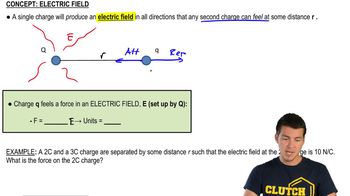
Electric Field

An electric field is a vector field that represents the force exerted by an electric charge on other charges in its vicinity. It is defined as the force per unit charge experienced by a positive test charge placed in the field. The electric field is measured in newtons per coulomb (N/C) and can be represented in component form, indicating its direction and magnitude along the x and y axes.
Recommended video:
Guided course
03:16
Intro to Electric Fields

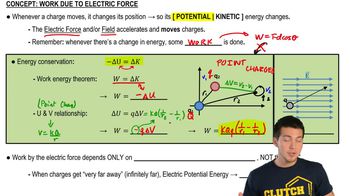
Electric Force

The electric force is the force experienced by a charged particle in an electric field. It is calculated using Coulomb's law, which states that the force (F) on a charge (q) in an electric field (E) is given by F = qE. This force is also a vector quantity, meaning it has both magnitude and direction, and is influenced by the charge of the particle and the strength of the electric field.
Recommended video:
Guided course
14:21
Work due to Electric Force

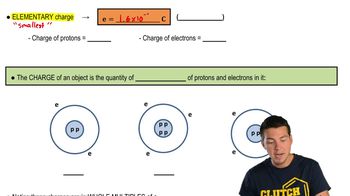
Proton Charge

A proton is a positively charged subatomic particle found in the nucleus of an atom, with a charge of approximately +1.6 x 10^-19 coulombs. When calculating the electric force on a proton in an electric field, its positive charge means that the force will act in the same direction as the electric field vector. Understanding the charge of the proton is essential for determining the resultant electric force acting on it.
Recommended video:
Guided course
05:37
Electric Charge