Ch 22: Electric Charges and Forces
Knight Calc - Physics for Scientists and Engineers 5th Edition
Knight Calc5th EditionPhysics for Scientists and EngineersISBN: 9780137344796Not the one you use?Change textbook
Chapter 22, Problem 32

A 12nC-12\,\(\text{nC}\) charge is located at (x,y)=(1.0cm,0cm)(x, y)=(1.0\,\(\text{cm}\), 0\,\(\text{cm}\)). What are the electric fields at the positions (x,y)=(5.0cm,0cm),(5.0cm,0cm)(x,y)=(5.0\,\(\text{cm}\),0\,\(\text{cm}\)),(-5.0\,\(\text{cm}\),0\,\(\text{cm)}\), and (0cm,5.0cm)(0\,\(\text{cm}\), 5.0\,\(\text{cm}\))? Write each electric field vector in component form.

Verified step by step guidance
1
Step 1: Recall the formula for the electric field due to a point charge: E = k_e * |q| / r^2, where k_e is Coulomb's constant (8.99 × 10^9 \, N·m^2/C^2), q is the charge, and r is the distance between the charge and the point where the field is being calculated.
Step 2: Convert all distances to meters. The charge is located at (1.0 cm, 0 cm), which is (0.01 m, 0 m). The positions where the electric field is to be calculated are (5.0 cm, 0 cm) = (0.05 m, 0 m), (−5.0 cm, 0 cm) = (−0.05 m, 0 m), and (0 cm, 5.0 cm) = (0 m, 0.05 m).
Step 3: Calculate the distance r between the charge and each point. For example, for (5.0 cm, 0 cm), r = |x_2 - x_1|, where x_1 = 0.01 \, m and x_2 = 0.05 \, m. Repeat this for the other two points.
Step 4: Determine the direction of the electric field. The electric field vector points away from the charge if it is positive and toward the charge if it is negative. Since the charge is -12 \, nC, the electric field vectors will point toward the charge. Use the relative positions of the charge and the points to determine the components of the electric field vector.
Step 5: Substitute the values of k_e, q, and r into the formula for the electric field. For each point, calculate the magnitude of the electric field and then resolve it into components based on the direction determined in Step 4. Write the electric field vectors in component form for each position.

Verified video answer for a similar problem:

This video solution was recommended by our tutors as helpful for the problem above.
Video duration:
8m
Was this helpful?

Key Concepts

Here are the essential concepts you must grasp in order to answer the question correctly.

Electric Field

The electric field is a vector field that represents the force exerted by an electric charge on other charges in its vicinity. It is defined as the force per unit charge experienced by a positive test charge placed in the field. The direction of the electric field is away from positive charges and towards negative charges, and its magnitude decreases with distance from the charge.
Recommended video:
Guided course
03:16
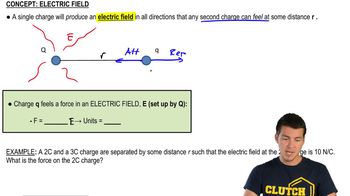
Intro to Electric Fields

Coulomb's Law

Coulomb's Law describes the electrostatic interaction between charged particles. It states that the force between two point charges is directly proportional to the product of the magnitudes of the charges and inversely proportional to the square of the distance between them. This law is fundamental for calculating the electric field generated by a point charge at a given location.
Recommended video:
Guided course
09:52
Coulomb's Law

Vector Components

Vectors can be broken down into their components along the coordinate axes, typically x and y in two-dimensional space. This decomposition allows for easier calculations and analysis of vector quantities, such as electric fields. The electric field vector can be expressed in component form as E = (Ex, Ey), where Ex and Ey are the electric field strengths in the x and y directions, respectively.
Recommended video:
Guided course
07:30
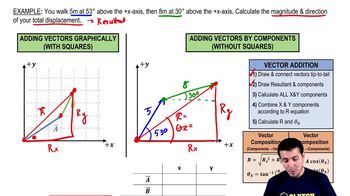
Vector Addition By Components