Ch 22: Electric Charges and Forces
Knight Calc - Physics for Scientists and Engineers 5th Edition
Knight Calc5th EditionPhysics for Scientists and EngineersISBN: 9780137344796Not the one you use?Change textbook
Chapter 22, Problem 27a

What are the strength and direction of the electric field 1.0 mm from a proton?

Verified step by step guidance
1
Step 1: Recall the formula for the electric field due to a point charge. The electric field \( E \) at a distance \( r \) from a point charge \( q \) is given by \( E = \frac{k \cdot q}{r^2} \), where \( k \) is Coulomb's constant \( k = 8.99 \times 10^9 \; \text{N·m}^2/\text{C}^2 \), \( q \) is the charge, and \( r \) is the distance from the charge.
Step 2: Identify the charge of a proton. A proton has a charge of \( q = +1.6 \times 10^{-19} \; \text{C} \). This is a positive charge, which means the electric field will point away from the proton.
Step 3: Convert the distance from millimeters to meters. Since \( 1.0 \; \text{mm} = 1.0 \times 10^{-3} \; \text{m} \), use \( r = 1.0 \times 10^{-3} \; \text{m} \) in the formula.
Step 4: Substitute the values into the formula \( E = \frac{k \cdot q}{r^2} \). Plug in \( k = 8.99 \times 10^9 \; \text{N·m}^2/\text{C}^2 \), \( q = +1.6 \times 10^{-19} \; \text{C} \), and \( r = 1.0 \times 10^{-3} \; \text{m} \).
Step 5: After substituting, simplify the expression to find the magnitude of the electric field. Remember that the direction of the electric field is radially outward from the proton because it is a positive charge.

Verified video answer for a similar problem:

This video solution was recommended by our tutors as helpful for the problem above.
Video duration:
2m
Was this helpful?

Key Concepts

Here are the essential concepts you must grasp in order to answer the question correctly.

Electric Field

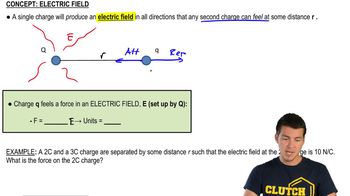
An electric field is a region around a charged particle where other charged particles experience a force. It is represented by vectors that indicate both the strength and direction of the force that a positive test charge would feel. The strength of the electric field (E) is defined as the force (F) per unit charge (q), given by the formula E = F/q.
Recommended video:
Guided course
03:16
Intro to Electric Fields

Coulomb's Law

Coulomb's Law describes the force between two point charges. It states that the magnitude of the electrostatic force (F) between two charges is directly proportional to the product of the magnitudes of the charges (q1 and q2) and inversely proportional to the square of the distance (r) between them. The law is mathematically expressed as F = k * (|q1 * q2| / r^2), where k is Coulomb's constant.
Recommended video:
Guided course
09:52
Coulomb's Law

Direction of Electric Field

The direction of the electric field created by a positive charge, such as a proton, is radially outward from the charge, while for a negative charge, it is directed inward toward the charge. This directional property is crucial for understanding how electric fields interact with other charges and how they influence the motion of charged particles in their vicinity.
Recommended video:
Guided course
03:16
Intro to Electric Fields