What is the force F on the 1.0 nC charge in FIGURE EX22.20? Give your answer as a magnitude and a direction.

Ch 22: Electric Charges and Forces
Knight Calc5th EditionPhysics for Scientists and EngineersISBN: 9780137344796Not the one you use?Change textbook
Chapter 22, Problem 22a
A 2.0 g plastic bead charged to −4.0 nC and a 4.0 g glass bead charged to +8.0 nC are 2.0 cm apart and free to move. What are the accelerations of the plastic bead?
Verified step by step guidance1
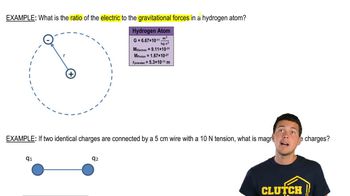
Identify the forces acting on the beads. The force between the two charged beads is given by Coulomb's law: , where is the Coulomb constant (), and are the charges of the beads, and is the distance between them.
Substitute the given values into Coulomb's law. Here, , , and . Calculate the magnitude of the force .
Determine the acceleration of the plastic bead using Newton's second law: . The mass of the plastic bead is . Use the force calculated in the previous step to find the acceleration of the plastic bead.
Determine the acceleration of the glass bead using the same formula, . The mass of the glass bead is . Use the same force (since the force is equal and opposite on both beads) to calculate the acceleration of the glass bead.
Summarize the results. The plastic bead and the glass bead experience equal and opposite forces due to Coulomb's law, but their accelerations differ because of their different masses. Ensure the directions of the accelerations are consistent with the attractive nature of the force (the plastic bead accelerates toward the glass bead, and vice versa).

Verified video answer for a similar problem:
This video solution was recommended by our tutors as helpful for the problem above.
Video duration:
5mWas this helpful?
Key Concepts
Here are the essential concepts you must grasp in order to answer the question correctly.
Coulomb's Law
Coulomb's Law describes the electrostatic force between two charged objects. It states that the force is directly proportional to the product of the magnitudes of the charges and inversely proportional to the square of the distance between them. This law is fundamental in calculating the forces acting on charged particles, which is essential for determining their accelerations.
Recommended video:
Guided course
Coulomb's Law
Newton's Second Law of Motion
Newton's Second Law states that the acceleration of an object is directly proportional to the net force acting on it and inversely proportional to its mass. This relationship is expressed by the formula F = ma, where F is the net force, m is the mass, and a is the acceleration. Understanding this law is crucial for calculating how the forces from the charged beads affect their motion.
Recommended video:
Guided course
Intro to Forces & Newton's Second Law
Mass and Charge
Mass and charge are fundamental properties of matter that influence how objects interact with forces. In this scenario, the mass of each bead affects how much they accelerate in response to the electrostatic forces calculated using Coulomb's Law. The charge determines the strength and direction of the forces acting on each bead, which is vital for solving the problem of their accelerations.
Recommended video:
Guided course
Find Mass-to-Charge Ratio in Spectrometer
Related Practice
Textbook Question
Textbook Question
What are the strength and direction of the electric field 1.0 mm from a proton?
Textbook Question
A massless spring is attached to a support at one end and has a 2.0 μC charge glued to the other end. A −4.0 μC charge is slowly brought near. The spring has stretched 1.2 cm when the charges are 2.6 cm apart. What is the spring constant of the spring?
Textbook Question
Two protons are 2.0 fm apart. What is the magnitude of the gravitational force on one proton due to the other proton?
Textbook Question
What is the magnitude of the net force on charge A in FIGURE EX22.17?
Textbook Question
The electric field at a point in space is N/C. What is the electric force on a proton at this point? Give your answer in component form.