Ch 22: Electric Charges and Forces
Knight Calc - Physics for Scientists and Engineers 5th Edition
Knight Calc5th EditionPhysics for Scientists and EngineersISBN: 9780137344796Not the one you use?Change textbook
Chapter 22, Problem 34b

A 0.10 g honeybee acquires a charge of +23 pC while flying. What electric field (strength and direction) would allow the bee to hang suspended in the air?

Verified step by step guidance
1
Step 1: Begin by identifying the forces acting on the honeybee. The honeybee is suspended in the air, meaning the electric force acting on it must balance the gravitational force. The gravitational force can be calculated using the formula: Fg=mg, where m is the mass of the honeybee and g is the acceleration due to gravity (approximately 9.8 m/s²).
Step 2: Calculate the gravitational force acting on the honeybee. Convert the mass of the honeybee from grams to kilograms (0.10 g = 0.0001 kg) and substitute it into the formula for gravitational force: Fg=0.0001×9.8. This gives the magnitude of the gravitational force.
Step 3: Recall the formula for electric force: Fe=qE, where q is the charge on the honeybee and E is the electric field strength. To suspend the honeybee, the electric force must equal the gravitational force: Fe=Fg. Substitute the expression for Fe into this equation: qE=mg.
Step 4: Solve for the electric field strength E. Rearrange the equation to isolate E: E=mg/q. Substitute the values for m (0.0001 kg), g (9.8 m/s²), and q (+23 pC = 23 × 10⁻¹² C).
Step 5: Determine the direction of the electric field. Since the honeybee has a positive charge, the electric field must point upward to exert an upward force on the honeybee, counteracting the downward gravitational force. This ensures the honeybee remains suspended in the air.

Verified video answer for a similar problem:

This video solution was recommended by our tutors as helpful for the problem above.
Video duration:
7m
Was this helpful?

Key Concepts

Here are the essential concepts you must grasp in order to answer the question correctly.

Electric Field

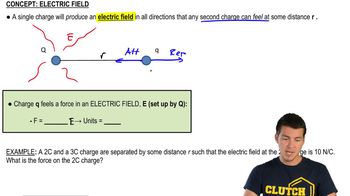
An electric field is a region around a charged particle where other charged particles experience a force. It is represented by the symbol E and is measured in newtons per coulomb (N/C). The direction of the electric field is defined as the direction a positive test charge would move in the field. Understanding electric fields is crucial for analyzing the forces acting on charged objects, such as the honeybee in this scenario.
Recommended video:
Guided course
03:16
Intro to Electric Fields

Force on a Charged Particle

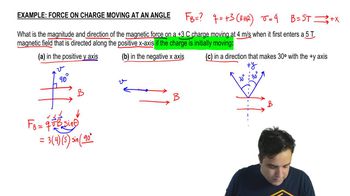
The force experienced by a charged particle in an electric field is given by Coulomb's law, expressed as F = qE, where F is the force, q is the charge of the particle, and E is the electric field strength. This relationship indicates that the force is directly proportional to both the charge and the strength of the electric field. In the case of the honeybee, this force must counteract its weight to achieve suspension in the air.
Recommended video:
Guided course
06:21
Force on Charge Moving at an Angle

Weight of the Honeybee

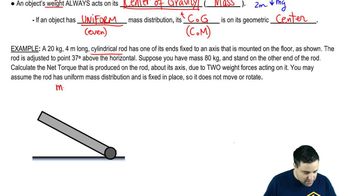
The weight of an object is the force exerted on it due to gravity, calculated as W = mg, where m is the mass and g is the acceleration due to gravity (approximately 9.81 m/s² on Earth). For the honeybee, with a mass of 0.10 g (or 0.0001 kg), its weight must be determined to find the necessary electric field that will balance this force, allowing the bee to remain suspended in the air.
Recommended video:
Guided course
10:19
Torque Due to Weight