Ch 19: Work, Heat, and the First Law of Thermodynamics
Knight Calc - Physics for Scientists and Engineers 5th Edition
Knight Calc5th EditionPhysics for Scientists and EngineersISBN: 9780137344796Not the one you use?Change textbook
Chapter 19, Problem 61a

Two cylinders each contain 0.10 mol of a diatomic gas at 300 K and a pressure of 3.0 atm. Cylinder A expands isothermally and cylinder B expands adiabatically until the pressure of each is 1.0 atm. What are the final temperature and volume of each?

Verified step by step guidance
1
Step 1: Begin by identifying the key concepts involved in the problem. Cylinder A undergoes an isothermal expansion, meaning the temperature remains constant throughout the process. Cylinder B undergoes an adiabatic expansion, meaning no heat is exchanged with the surroundings. Use the ideal gas law and thermodynamic principles to solve for the final temperature and volume of each cylinder.
Step 2: For Cylinder A (isothermal expansion), use the ideal gas law, \( PV = nRT \), where \( P \) is pressure, \( V \) is volume, \( n \) is the number of moles, \( R \) is the gas constant, and \( T \) is temperature. Since \( T \) is constant, the relationship \( P_1V_1 = P_2V_2 \) applies. Solve for \( V_2 \) using \( V_2 = \frac{P_1V_1}{P_2} \).
Step 3: For Cylinder B (adiabatic expansion), use the adiabatic process equation \( P_1V_1^\gamma = P_2V_2^\gamma \), where \( \gamma \) is the adiabatic index (\( \gamma = \frac{C_p}{C_v} \) for a diatomic gas, typically \( \gamma = 1.4 \)). Solve for \( V_2 \) using \( V_2 = \left( \frac{P_1}{P_2} \right)^{\frac{1}{\gamma}} V_1 \).
Step 4: For Cylinder B, calculate the final temperature \( T_2 \) using the relationship \( T_2 = T_1 \left( \frac{P_2}{P_1} \right)^{\frac{\gamma - 1}{\gamma}} \). This equation comes from the combination of the ideal gas law and the adiabatic process equation.
Step 5: To find the initial volume \( V_1 \) for both cylinders, use the ideal gas law \( V_1 = \frac{nRT}{P_1} \). Substitute \( n = 0.10 \) mol, \( R = 0.0821 \, \text{L·atm/(mol·K)} \), \( T = 300 \, \text{K} \), and \( P_1 = 3.0 \, \text{atm} \). Use this \( V_1 \) value in the equations derived for \( V_2 \) and \( T_2 \).

Verified video answer for a similar problem:

This video solution was recommended by our tutors as helpful for the problem above.
Video duration:
18m
Was this helpful?

Key Concepts

Here are the essential concepts you must grasp in order to answer the question correctly.

Isothermal Process

An isothermal process occurs at a constant temperature, meaning that any heat added to the system is used to do work rather than change the internal energy. For an ideal gas, this implies that the product of pressure and volume remains constant (PV = nRT). In the context of the question, Cylinder A's expansion is isothermal, allowing us to calculate its final volume and temperature using the ideal gas law.
Recommended video:
Guided course
06:13
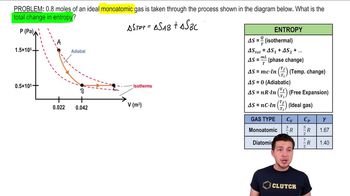
Entropy & Ideal Gas Processes

Adiabatic Process

An adiabatic process is one in which no heat is exchanged with the surroundings. For an ideal gas undergoing adiabatic expansion, the relationship between pressure, volume, and temperature is governed by the adiabatic condition, which can be expressed as PV^γ = constant, where γ (gamma) is the heat capacity ratio. This concept is crucial for analyzing Cylinder B's expansion, as it allows us to determine the final temperature and volume after the pressure drops.
Recommended video:
Guided course
06:13
Entropy & Ideal Gas Processes

Ideal Gas Law

The ideal gas law is a fundamental equation in thermodynamics that relates the pressure, volume, temperature, and number of moles of a gas. It is expressed as PV = nRT, where P is pressure, V is volume, n is the number of moles, R is the ideal gas constant, and T is temperature. This law is essential for solving the final states of both cylinders after their respective expansions, as it provides the necessary relationships between the variables involved.
Recommended video:
Guided course
07:21
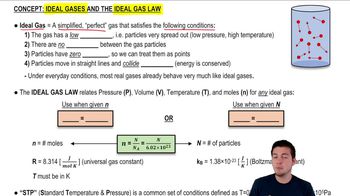
Ideal Gases and the Ideal Gas Law