Liquid helium, with a boiling point of 4.2 K, is used in ultralow-temperature experiments and also for cooling the superconducting magnets used in MRI imaging in medicine. Storing liquid helium so far below room temperature is a challenge because even a small 'heat leak' will boil the helium away. A standard helium dewar, shown in FIGURE P19.67, has an inner stainless-steel cylinder filled with liquid helium surrounded by an outer cylindrical shell filled with liquid nitrogen at –196°C. The space between is a vacuum. The small structural supports have very low thermal conductivity, so you can assume that radiation is the only heat transfer between the helium and its surroundings. Suppose the helium cylinder is 16 cm in diameter and 30 cm tall and that all walls have an emissivity of 0.25. The density of liquid helium is 125 kg/m3 and its heat of vaporization is 2.1×10⁴ J/kg. What is the mass of helium in the filled cylinder?

- Ch 01: Concepts of Motion35
- Ch 02: Kinematics in One Dimension75
- Ch 03: Vectors and Coordinate Systems58
- Ch 04: Kinematics in Two Dimensions60
- Ch 05: Force and Motion23
- Ch 06: Dynamics I: Motion Along a Line53
- Ch 07: Newton's Third Law27
- Ch 08: Dynamics II: Motion in a Plane52
- Ch 09: Work and Kinetic Energy56
- Ch 10: Interactions and Potential Energy50
- Ch 11: Impulse and Momentum56
- Ch 12: Rotation of a Rigid Body71
- Ch 13: Newton's Theory of Gravity52
- Ch 14: Fluids and Elasticity44
- Ch 15: Oscillations55
- Ch 16: Traveling Waves37
- Ch 17: Superposition39
- Ch 18: A Macroscopic Description of Matter53
- Ch 19: Work, Heat, and the First Law of Thermodynamics60
- Ch 20: The Micro/Macro Connection53
- Ch 21: Heat Engines and Refrigerators34
- Ch 22: Electric Charges and Forces40
- Ch 23: The Electric Field39
- Ch 24: Gauss' Law32
- Ch 25: The Electric Potential63
- Ch 26: Potential and Field57
- Ch 27: Current and Resistance42
- Ch 28: Fundamentals of Circuits39
- Ch 29: The Magnetic Field47
- Ch 30: Electromagnetic Induction60
- Ch 31: Electromagnetic Fields and Waves32
- Ch 32: AC Circuits63
- Ch 33: Wave Optics32
- Ch 34: Ray Optics57
- Ch 35: Optical Instruments30
- Ch 36: Special Relativity38
- Ch 37: The Foundations of Modern Physics25
- Ch 38: Quantization49
- Ch 39: Wave Functions and Uncertainty31
- Ch 40: One-Dimensional Quantum Mechanics35
- Ch 41: Atomic Physics18
- Ch 42: Nuclear Physics27
 Knight Calc 5th EditionCh 19: Work, Heat, and the First Law of ThermodynamicsProblem 64d
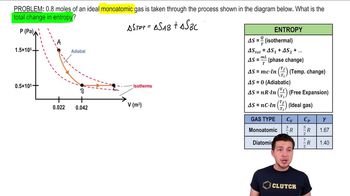
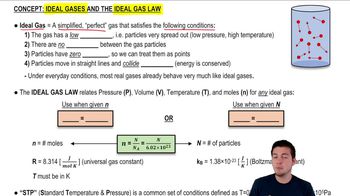
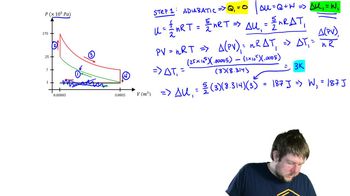
14 g of nitrogen gas at STP are adiabatically compressed to a pressure of 20 atm. What is the compression ratio Vmax/Vmin?
 Verified step by step guidance
Verified video answer for a similar problem:
Key Concepts
Adiabatic Process
 06:13
06:13
Ideal Gas Law
 07:21
07:21Compression Ratio
 17:42
17:42FIGURE P19.62 shows a thermodynamic process followed by 120 mg of helium. How much heat energy is transferred to or from the gas during each of the three segments?
Two cylinders each contain 0.10 mol of a diatomic gas at 300 K and a pressure of 3.0 atm. Cylinder A expands isothermally and cylinder B expands adiabatically until the pressure of each is 1.0 atm. What are the final temperature and volume of each?
A monatomic gas is adiabatically compressed to 1/8 of its initial volume. Does each of the following quantities change? If so, does it increase or decrease, and by what factor? If not, why not? The molar specific heat at constant volume.
14 g of nitrogen gas at STP are pressurized in an isochoric process to a pressure of 20 atm. What are the final temperature?
FIGURE P19.62 shows a thermodynamic process followed by 120 mg of helium. How much work is done on the gas during each of the three segments?