Ch 19: Work, Heat, and the First Law of Thermodynamics
Knight Calc - Physics for Scientists and Engineers 5th Edition
Knight Calc5th EditionPhysics for Scientists and EngineersISBN: 9780137344796Not the one you use?Change textbook
Chapter 19, Problem 62c

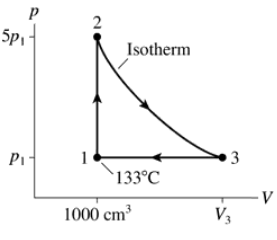
FIGURE P19.62 shows a thermodynamic process followed by 120 mg of helium. How much heat energy is transferred to or from the gas during each of the three segments?

Verified step by step guidance
1
Step 1: Identify the type of thermodynamic process for each segment (e.g., isothermal, isobaric, isochoric) based on the information provided in the problem or figure. Each type of process has a specific formula for calculating heat transfer.
Step 2: Use the first law of thermodynamics, which states ΔU = Q - W, where ΔU is the change in internal energy, Q is the heat transfer, and W is the work done by the gas. Rearrange this equation as needed to solve for Q.
Step 3: For each segment, calculate the work done (W) using the appropriate formula. For example, for an isothermal process, W = nRT ln(Vf/Vi), and for an isobaric process, W = PΔV. Ensure you have the necessary variables such as pressure (P), volume (V), and temperature (T).
Step 4: Calculate the change in internal energy (ΔU) for each segment. For a monatomic ideal gas like helium, ΔU = (3/2)nRΔT, where n is the number of moles, R is the ideal gas constant, and ΔT is the change in temperature.
Step 5: Combine the values of ΔU and W for each segment to find the heat transfer (Q) using the rearranged first law of thermodynamics. Repeat this process for all three segments to determine the heat energy transferred to or from the gas in each case.

Verified video answer for a similar problem:

This video solution was recommended by our tutors as helpful for the problem above.
Was this helpful?

Key Concepts

Here are the essential concepts you must grasp in order to answer the question correctly.

Thermodynamic Processes

Thermodynamic processes describe the changes in state of a system, such as a gas, as it exchanges energy with its surroundings. These processes can be classified into isothermal, adiabatic, isobaric, and isochoric, each characterized by specific conditions regarding temperature, pressure, and volume. Understanding these processes is essential for analyzing how heat energy is transferred during each segment of the process.
Recommended video:
Guided course
08:45
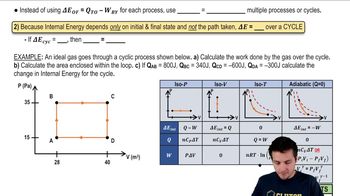
Properties of Cyclic Thermodynamic Processes

Heat Transfer

Heat transfer refers to the movement of thermal energy from one object or system to another due to a temperature difference. It can occur through conduction, convection, or radiation. In the context of thermodynamic processes, calculating the heat transferred involves applying the first law of thermodynamics, which relates internal energy changes to heat added or removed and work done by or on the system.
Recommended video:
Guided course
05:14
Overview of Heat Transfer

Specific Heat Capacity

Specific heat capacity is the amount of heat required to change the temperature of a unit mass of a substance by one degree Celsius. For gases, this value can vary depending on whether the process is at constant volume or constant pressure. Knowing the specific heat capacity of helium is crucial for determining the heat energy transferred during the segments of the thermodynamic process described in the question.
Recommended video:
Guided course
06:50
Specific Heat & Temperature Changes