Ch 19: Work, Heat, and the First Law of Thermodynamics
Knight Calc - Physics for Scientists and Engineers 5th Edition
Knight Calc5th EditionPhysics for Scientists and EngineersISBN: 9780137344796Not the one you use?Change textbook
Chapter 19, Problem 62b

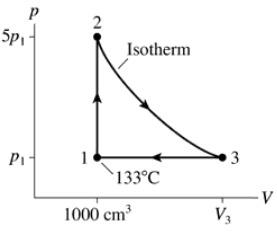
FIGURE P19.62 shows a thermodynamic process followed by 120 mg of helium. How much work is done on the gas during each of the three segments?

Verified step by step guidance
1
Step 1: Identify the three segments of the thermodynamic process from the graph. Segment 1→2 is an isothermal expansion, Segment 2→3 is an isochoric process (constant volume), and Segment 3→1 is an isobaric compression (constant pressure).
Step 2: For the isothermal process (1→2), use the formula for work done during an isothermal process: \( W = nRT \ln \left( \frac{V_2}{V_1} \right) \). Here, \( n \) is the number of moles, \( R \) is the gas constant, \( T \) is the temperature, and \( V_1 \) and \( V_2 \) are the initial and final volumes.
Step 3: For the isochoric process (2→3), note that no work is done because the volume remains constant. Work done in an isochoric process is always zero: \( W = 0 \).
Step 4: For the isobaric process (3→1), use the formula for work done during an isobaric process: \( W = -P \Delta V \), where \( P \) is the constant pressure and \( \Delta V \) is the change in volume (\( V_1 - V_3 \)). The negative sign indicates work done on the gas.
Step 5: Calculate the number of moles of helium gas using \( n = \frac{m}{M} \), where \( m \) is the mass of helium (120 mg = 0.120 g) and \( M \) is the molar mass of helium (4 g/mol). Substitute \( n \) into the equations for the isothermal and isobaric processes to determine the work done for each segment.

Key Concepts

Here are the essential concepts you must grasp in order to answer the question correctly.

Work Done on a Gas

In thermodynamics, the work done on a gas during a process can be calculated using the area under the pressure-volume (P-V) curve. For processes where the volume changes, work is defined as the integral of pressure with respect to volume. Depending on the path taken in the P-V diagram, the work can vary, making it essential to analyze each segment of the process separately.
Recommended video:
Guided course
03:47
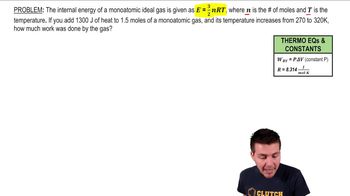
Calculating Work Done on Monoatomic Gas

Isothermal Process

An isothermal process occurs at a constant temperature, meaning that the internal energy of an ideal gas remains unchanged. In the P-V diagram, this is represented by a hyperbolic curve. For helium gas, which is ideal, the work done during an isothermal expansion or compression can be calculated using the formula W = nRT ln(Vf/Vi), where n is the number of moles, R is the gas constant, and Vf and Vi are the final and initial volumes, respectively.
Recommended video:
Guided course
06:13
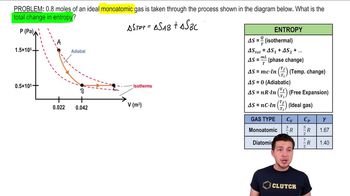
Entropy & Ideal Gas Processes

Thermodynamic Variables

Thermodynamic variables such as pressure (P), volume (V), and temperature (T) are fundamental in describing the state of a gas. In the context of the given question, understanding how these variables interact during different segments of the process is crucial. For example, the relationship between pressure and volume is described by Boyle's Law for isothermal processes, which states that P1V1 = P2V2, highlighting the inverse relationship between pressure and volume at constant temperature.
Recommended video:
Guided course
05:28
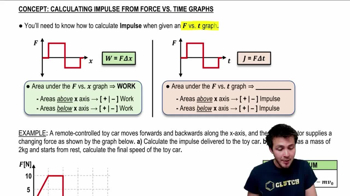
Impulse with Variable Forces