Textbook Question
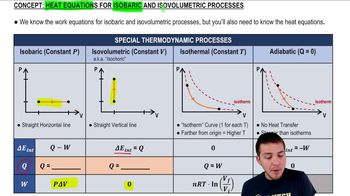
0.10 mol of nitrogen gas follow the two processes shown in FIGURE P19.58. How much heat is required for each?
1
views

 Knight Calc 5th EditionCh 19: Work, Heat, and the First Law of ThermodynamicsProblem 57d
 Verified step by step guidance
 06:44
06:44
 08:04
08:04 05:14
05:140.10 mol of nitrogen gas follow the two processes shown in FIGURE P19.58. How much heat is required for each?
5.0 g of nitrogen gas at 20°C and an initial pressure of 3.0 atm undergo an isobaric expansion until the volume has tripled. How much heat energy is transferred to the gas to cause this expansion?
Two cylinders each contain 0.10 mol of a diatomic gas at 300 K and a pressure of 3.0 atm. Cylinder A expands isothermally and cylinder B expands adiabatically until the pressure of each is 1.0 atm. What are the final temperature and volume of each?
5.0 g of nitrogen gas at 20°C and an initial pressure of 3.0 atm undergo an isobaric expansion until the volume has tripled. What are the gas volume and temperature after the expansion?
5.0 g of nitrogen gas at 20°C and an initial pressure of 3.0 atm undergo an isobaric expansion until the volume has tripled. What is the gas pressure after the decrease?
FIGURE P19.62 shows a thermodynamic process followed by 120 mg of helium. How much work is done on the gas during each of the three segments?