Ch 19: Work, Heat, and the First Law of Thermodynamics
Knight Calc - Physics for Scientists and Engineers 5th Edition
Knight Calc5th EditionPhysics for Scientists and EngineersISBN: 9780137344796Not the one you use?Change textbook
Chapter 19, Problem 57a

5.0 g of nitrogen gas at 20°C and an initial pressure of 3.0 atm undergo an isobaric expansion until the volume has tripled. What are the gas volume and temperature after the expansion?

Verified step by step guidance
1
Step 1: Start by identifying the given values and the type of process. The problem states that the gas undergoes an isobaric (constant pressure) expansion. Given values are: mass of nitrogen gas (m = 5.0 g), initial temperature (T₁ = 20°C = 293 K), initial pressure (P = 3.0 atm), and the final volume is three times the initial volume (V₂ = 3V₁).
Step 2: Use the ideal gas law to find the initial volume (V₁). The ideal gas law is given by: PV=nRT. First, calculate the number of moles (n) of nitrogen gas using its molar mass (M = 28.0 g/mol): n=mM. Substitute the values to find n.
Step 3: Rearrange the ideal gas law to solve for the initial volume (V₁): V=nRTP. Use the calculated value of n, the gas constant R (0.0821 L·atm/(mol·K)), the initial temperature T₁, and the pressure P to find V₁.
Step 4: Since the process is isobaric, the pressure remains constant. Use the relationship between temperature and volume for an isobaric process: V2V1=T2T1. Substitute V₂ = 3V₁ and solve for T₂: T2=3T1.
Step 5: Finally, calculate the final volume (V₂) and temperature (T₂). Use the values of V₁ and T₁ from the previous steps to determine V₂ and T₂. Ensure that the units are consistent throughout the calculations.

Verified video answer for a similar problem:

This video solution was recommended by our tutors as helpful for the problem above.
Video duration:
3m
Was this helpful?

Key Concepts

Here are the essential concepts you must grasp in order to answer the question correctly.

Ideal Gas Law

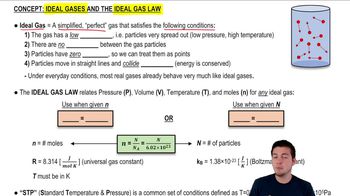
The Ideal Gas Law relates the pressure, volume, temperature, and number of moles of a gas through the equation PV = nRT. This law is essential for understanding the behavior of gases under varying conditions. In this scenario, it helps determine how the volume and temperature of nitrogen gas change during the isobaric expansion.
Recommended video:
Guided course
07:21
Ideal Gases and the Ideal Gas Law

Isobaric Process

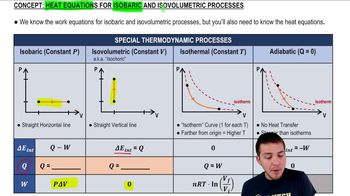
An isobaric process is a thermodynamic process in which the pressure remains constant. During this type of expansion, the volume of the gas increases while the pressure does not change, which directly affects the temperature according to the Ideal Gas Law. Understanding this concept is crucial for calculating the final temperature after the gas expands.
Recommended video:
Guided course
06:44
Heat Equations for Isobaric & Isovolumetric Processes

Charles's Law

Charles's Law states that the volume of a gas is directly proportional to its temperature when pressure is held constant. This principle is vital for solving the problem, as it allows us to relate the initial and final states of the gas during the isobaric expansion. By applying this law, we can find the new temperature after the volume has tripled.
Recommended video: