
Ch 17: Superposition
Knight Calc - Physics for Scientists and Engineers 5th Edition
Knight Calc5th EditionPhysics for Scientists and EngineersISBN: 9780137344796Not the one you use?Change textbook
Chapter 17, Problem 24

What is the thinnest film of MgF2 (n=1.39) on glass that produces a strong reflection for orange light with a wavelength of 600 nm?

Verified step by step guidance
1
Identify the condition for constructive interference in thin films. For a film with a lower refractive index (n=1.39) on a higher refractive index substrate (glass), the reflected light undergoes a phase shift of half a wavelength (λ/2) at the top surface. The condition for constructive interference is: 2 * n * t = m * λ, where t is the thickness of the film, n is the refractive index of the film, λ is the wavelength of light in vacuum, and m is an integer (order of interference).
Since the problem asks for the thinnest film, we use the first order of interference (m=1). Substitute m=1 into the equation: 2 * n * t = λ.
Rearrange the equation to solve for the thickness t: t = λ / (2 * n).
Substitute the given values into the equation. The wavelength of light in vacuum is λ = 600 nm, and the refractive index of the film is n = 1.39. Ensure the units are consistent (convert nanometers to meters if necessary).
Perform the calculation to find the thickness t. This will give the thinnest film of MgF₂ that produces a strong reflection for orange light with a wavelength of 600 nm.

Verified video answer for a similar problem:

This video solution was recommended by our tutors as helpful for the problem above.
Was this helpful?

Key Concepts

Here are the essential concepts you must grasp in order to answer the question correctly.

Thin Film Interference

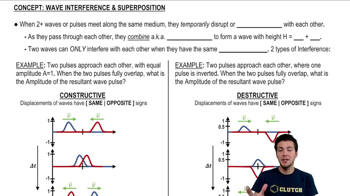
Thin film interference occurs when light waves reflect off the boundaries of a thin film, such as a soap bubble or a layer of MgF₂. The reflected waves can interfere constructively or destructively depending on the film's thickness and the wavelength of light. For strong reflection, constructive interference must occur, which is influenced by the film's refractive index and the wavelength of the incident light.
Recommended video:
Guided course
03:47
Wave Interference & Superposition

Refractive Index

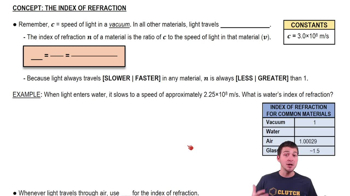
The refractive index (n) of a material indicates how much light slows down when entering that material compared to its speed in a vacuum. In this case, MgF₂ has a refractive index of 1.39, which affects how light reflects and refracts at the film's surface. The refractive index is crucial for determining the phase change that occurs upon reflection, which influences the conditions for constructive interference.
Recommended video:
Guided course
03:46
Index of Refraction

Wavelength and Film Thickness Relationship

The relationship between the wavelength of light and the thickness of the film is essential for achieving constructive interference. For a film of thickness t, the condition for strong reflection (constructive interference) is given by the equation 2nt = mλ, where m is an integer (order of interference) and λ is the wavelength of light in a vacuum. This relationship helps calculate the minimum thickness of the MgF₂ film needed to produce a strong reflection for the specified wavelength of 600 nm.
Recommended video:
Guided course
03:43
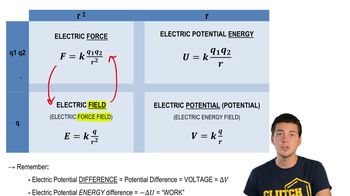
Relationships Between Force, Field, Energy, Potential
Related Practice
Textbook Question

Two loudspeakers emit sound waves along the x-axis. The sound has maximum intensity when the speakers are 20 cm apart. The sound intensity decreases as the distance between the speakers is increased, reaching zero at a separation of 60 cm. What is the wavelength of the sound?

1
views
Textbook Question

Two strings are adjusted to vibrate at exactly 200 Hz. Then the tension in one string is increased slightly. Afterward, three beats per second are heard when the strings vibrate at the same time. What is the new frequency of the string that was tightened?

2
views
Textbook Question

A 170-cm-long open-closed tube has a standing sound wave at 250 Hz on a day when the speed of sound is 340m/s . How many pressure antinodes are there, and how far is each from the open end of the tube?

1
views
Textbook Question

FIGURE EX17.27 shows the circular wave fronts emitted by two wave sources. Make a table with rows labeled P, Q, and R and columns labeled r1, r2, Δr, and C/D. Fill in the table for points P, Q, and R, giving the distances as multiples of λ and indicating, with a C or a D, whether the interference at that point is constructive or destructive.

3
views
Textbook Question

Two loudspeakers in a 20°C room emit 686 Hz sound waves along the x-axis. If the speakers are out of phase, what is the smallest distance between the speakers for which the interference of the sound waves is maximum constructive?

1
views
Textbook Question

Two out-of-phase radio antennas at x=±300 m on the x-axis are emitting 3.0 MHz radio waves. Is the point (x, y) =(300 m, 800 m) a point of maximum constructive interference, maximum destructive interference, or something in between?

1
views