
Ch 17: Superposition
Knight Calc - Physics for Scientists and Engineers 5th Edition
Knight Calc5th EditionPhysics for Scientists and EngineersISBN: 9780137344796Not the one you use?Change textbook
Chapter 17, Problem 33

Two strings are adjusted to vibrate at exactly 200 Hz. Then the tension in one string is increased slightly. Afterward, three beats per second are heard when the strings vibrate at the same time. What is the new frequency of the string that was tightened?

Verified step by step guidance
1
Step 1: Understand the concept of beats. Beats occur when two sound waves of slightly different frequencies interfere with each other. The beat frequency is equal to the absolute difference between the two frequencies: \( f_{beat} = |f_1 - f_2| \).
Step 2: Identify the given values. The original frequency of both strings is \( f_1 = 200 \, \text{Hz} \), and the beat frequency after tightening one string is \( f_{beat} = 3 \, \text{Hz} \).
Step 3: Use the beat frequency formula to determine the new frequency of the tightened string. Since \( f_{beat} = |f_1 - f_2| \), the new frequency \( f_2 \) could either be \( f_1 + f_{beat} \) or \( f_1 - f_{beat} \).
Step 4: Calculate the possible values for \( f_2 \). Substitute \( f_1 = 200 \, \text{Hz} \) and \( f_{beat} = 3 \, \text{Hz} \) into the formula: \( f_2 = 200 + 3 \) or \( f_2 = 200 - 3 \).
Step 5: Determine the correct value for \( f_2 \). Since the tension in the string was increased, the frequency of the tightened string must increase. Therefore, the new frequency of the tightened string is \( f_2 = 200 + 3 \, \text{Hz} \).

Verified video answer for a similar problem:

This video solution was recommended by our tutors as helpful for the problem above.
Video duration:
3m
Was this helpful?

Key Concepts

Here are the essential concepts you must grasp in order to answer the question correctly.

Frequency

Frequency is the number of cycles of a periodic wave that occur in one second, measured in hertz (Hz). In this context, both strings initially vibrate at a frequency of 200 Hz, meaning they complete 200 cycles per second. When the tension in one string is increased, its frequency will change, which is crucial for understanding the resulting beat frequency.
Recommended video:
Guided course
05:08
Circumference, Period, and Frequency in UCM

Beats

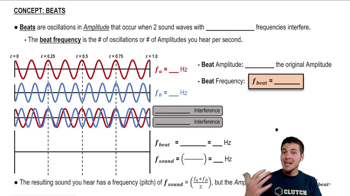
Beats occur when two sound waves of slightly different frequencies interfere with each other, resulting in a fluctuating sound intensity. The beat frequency is equal to the absolute difference between the two frequencies. In this scenario, hearing three beats per second indicates that the frequency of the tightened string is either 203 Hz or 197 Hz, as the difference from the original frequency of 200 Hz must equal 3 Hz.
Recommended video:

Tension and Frequency Relationship

The frequency of a vibrating string is directly related to the tension in the string. Increasing the tension raises the frequency, while decreasing it lowers the frequency. This relationship is described by the formula f = (1/2L)√(T/μ), where f is frequency, L is the length of the string, T is tension, and μ is the linear mass density. Understanding this concept is essential to determine the new frequency after the tension adjustment.
Recommended video:
Guided course
05:08
Circumference, Period, and Frequency in UCM
Related Practice
Textbook Question

FIGURE EX17.27 shows the circular wave fronts emitted by two wave sources. Make a table with rows labeled P, Q, and R and columns labeled r1, r2, Δr, and C/D. Fill in the table for points P, Q, and R, giving the distances as multiples of λ and indicating, with a C or a D, whether the interference at that point is constructive or destructive.

3
views
Textbook Question

A 2.0-m-long string vibrates at its second-harmonic frequency with a maximum amplitude of 2.0 cm. One end of the string is at x = 0 cm. Find the oscillation amplitude at x = 10, 20, 30, 40, and 50 cm.

3
views
Textbook Question

What is the thinnest film of MgF2 (n=1.39) on glass that produces a strong reflection for orange light with a wavelength of 600 nm?

2
views
Textbook Question

A flute player hears four beats per second when she compares her note to a 523 Hz tuning fork (the note C). She can match the frequency of the tuning fork by pulling out the 'tuning joint' to lengthen her flute slightly. What was her initial frequency?

1
views
Textbook Question

Two out-of-phase radio antennas at x=±300 m on the x-axis are emitting 3.0 MHz radio waves. Is the point (x, y) =(300 m, 800 m) a point of maximum constructive interference, maximum destructive interference, or something in between?

1
views
Textbook Question

Tendons are, essentially, elastic cords stretched between two fixed ends. As such, they can support standing waves. A woman has a 20-cm-long Achilles tendon—connecting the heel to a muscle in the calf—with a cross-section area of 90 mm2 . The density of tendon tissue is 1100 kg/m3. For a reasonable tension of 500 N, what will be the fundamental frequency of her Achilles tendon?

1
views