
Ch 17: Superposition
Knight Calc - Physics for Scientists and Engineers 5th Edition
Knight Calc5th EditionPhysics for Scientists and EngineersISBN: 9780137344796Not the one you use?Change textbook
Chapter 17, Problem 22a

Two loudspeakers emit sound waves along the x-axis. The sound has maximum intensity when the speakers are 20 cm apart. The sound intensity decreases as the distance between the speakers is increased, reaching zero at a separation of 60 cm. What is the wavelength of the sound?

Verified step by step guidance
1
Understand the problem: The sound waves from the two speakers interfere with each other. Maximum intensity occurs when the waves are in phase (constructive interference), and zero intensity occurs when the waves are out of phase (destructive interference). The goal is to find the wavelength of the sound.
Recall the condition for destructive interference: Destructive interference occurs when the path difference between the two waves is an odd multiple of half the wavelength, i.e., \( \Delta x = (m + \frac{1}{2}) \lambda \), where \( m \) is an integer.
Identify the given data: The distance between the speakers changes from 20 cm (maximum intensity) to 60 cm (zero intensity). The change in distance corresponds to a transition from constructive to destructive interference. This means the path difference changes by half a wavelength.
Set up the relationship: The change in distance between the speakers is \( 60 \ \text{cm} - 20 \ \text{cm} = 40 \ \text{cm} \). This change corresponds to half a wavelength, so \( \frac{1}{2} \lambda = 40 \ \text{cm} \).
Solve for the wavelength: Multiply both sides of the equation \( \frac{1}{2} \lambda = 40 \ \text{cm} \) by 2 to find \( \lambda \). The wavelength \( \lambda \) is twice the change in distance.

Verified video answer for a similar problem:

This video solution was recommended by our tutors as helpful for the problem above.
Video duration:
6m
Was this helpful?

Key Concepts

Here are the essential concepts you must grasp in order to answer the question correctly.

Interference of Sound Waves

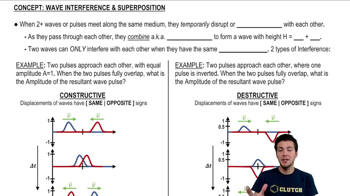
Interference occurs when two or more sound waves overlap, resulting in a new wave pattern. Constructive interference happens when waves are in phase, amplifying sound intensity, while destructive interference occurs when waves are out of phase, reducing intensity. The distance between the speakers affects the interference pattern, leading to regions of maximum and minimum sound intensity.
Recommended video:
Guided course
03:47
Wave Interference & Superposition

Wavelength

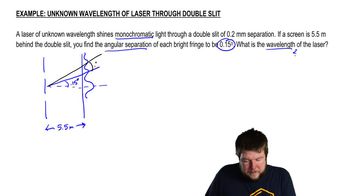
Wavelength is the distance between successive crests (or troughs) of a wave. It is a fundamental property of waves, including sound, and is inversely related to frequency. In the context of sound waves from the speakers, the wavelength can be determined by analyzing the distance at which constructive and destructive interference occurs.
Recommended video:
Guided course
05:42
Unknown Wavelength of Laser through Double Slit

Sound Intensity

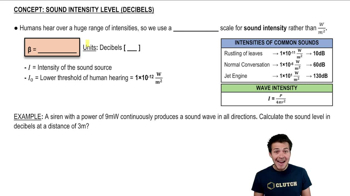
Sound intensity is the power per unit area carried by a sound wave and is typically measured in watts per square meter. It is influenced by the amplitude of the sound wave and the distance from the source. In this scenario, the intensity varies with the distance between the speakers, indicating how sound waves interact and affect perceived loudness.
Recommended video:
Guided course
04:25
Sound Intensity Level and the Decibel Scale
Related Practice
Textbook Question

A bass clarinet can be modeled as a 120-cm-long open-closed tube. A bass clarinet player starts playing in a 20° C room, but soon the air inside the clarinet warms to where the speed of sound is 352m/s . Does the fundamental frequency increase or decrease? By how much?

1
views
Textbook Question

A 170-cm-long open-closed tube has a standing sound wave at 250 Hz on a day when the speed of sound is 340m/s . How many pressure antinodes are there, and how far is each from the open end of the tube?

1
views
Textbook Question

FIGURE EX17.27 shows the circular wave fronts emitted by two wave sources. Make a table with rows labeled P, Q, and R and columns labeled r1, r2, Δr, and C/D. Fill in the table for points P, Q, and R, giving the distances as multiples of λ and indicating, with a C or a D, whether the interference at that point is constructive or destructive.

3
views
Textbook Question

What is the thinnest film of MgF2 (n=1.39) on glass that produces a strong reflection for orange light with a wavelength of 600 nm?

2
views
Textbook Question

Two loudspeakers in a 20°C room emit 686 Hz sound waves along the x-axis. If the speakers are out of phase, what is the smallest distance between the speakers for which the interference of the sound waves is maximum constructive?

1
views
Textbook Question

The lowest note on a grand piano has a frequency of 27.5 Hz. The entire string is 2.00 m long and has a mass of 400 g. The vibrating section of the string is 1.90 m long. What tension is needed to tune this string properly?

6
views