
Ch 17: Superposition
Knight Calc - Physics for Scientists and Engineers 5th Edition
Knight Calc5th EditionPhysics for Scientists and EngineersISBN: 9780137344796Not the one you use?Change textbook
Chapter 17, Problem 23b

Two loudspeakers in a 20°C room emit 686 Hz sound waves along the x-axis. If the speakers are out of phase, what is the smallest distance between the speakers for which the interference of the sound waves is maximum constructive?

Verified step by step guidance
1
Step 1: Recall the condition for maximum constructive interference. For two waves to interfere constructively, the path difference between them must be an integer multiple of the wavelength (nλ, where n is an integer).
Step 2: Calculate the wavelength of the sound waves using the formula λ = v / f, where v is the speed of sound and f is the frequency. At 20°C, the speed of sound in air is approximately 343 m/s. Substitute v = 343 m/s and f = 686 Hz into the formula.
Step 3: Since the speakers are out of phase, the condition for maximum constructive interference changes slightly. The path difference must now be an odd multiple of half the wavelength ((2n + 1)λ/2, where n is an integer). Start with the smallest odd multiple, which corresponds to n = 0.
Step 4: Substitute n = 0 into the formula for the path difference ((2n + 1)λ/2) to find the smallest distance between the speakers for maximum constructive interference. Use the wavelength calculated in Step 2.
Step 5: Interpret the result physically. The smallest distance corresponds to the point where the sound waves from the two speakers combine constructively despite being out of phase, due to the specific path difference satisfying the interference condition.

Verified video answer for a similar problem:

This video solution was recommended by our tutors as helpful for the problem above.
Video duration:
4m
Was this helpful?

Key Concepts

Here are the essential concepts you must grasp in order to answer the question correctly.

Sound Waves

Sound waves are longitudinal waves that propagate through a medium, such as air, by compressing and rarefying the particles in that medium. The frequency of a sound wave, measured in hertz (Hz), determines its pitch. In this scenario, the speakers emit sound waves at a frequency of 686 Hz, which is essential for understanding how these waves interact.
Recommended video:
Guided course
05:17
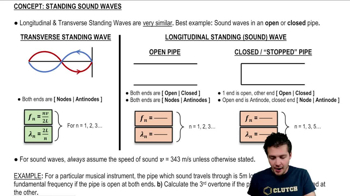
Standing Sound Waves

Interference

Interference occurs when two or more waves overlap and combine to form a new wave pattern. In the case of sound waves, this can result in constructive interference, where the waves reinforce each other, leading to increased amplitude, or destructive interference, where they cancel each other out. The phase relationship between the waves is crucial in determining the type of interference that occurs.
Recommended video:
Guided course
03:47
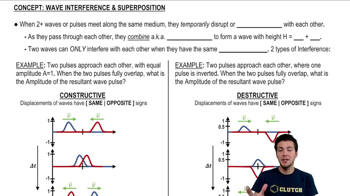
Wave Interference & Superposition

Path Difference

Path difference refers to the difference in distance traveled by two waves from their sources to a common point. For constructive interference to occur, the path difference must be an integer multiple of the wavelength. In this problem, determining the smallest distance between the speakers that results in maximum constructive interference involves calculating the wavelength of the sound waves and applying the condition for constructive interference.
Recommended video:
Guided course
08:20
Mean Free Path
Related Practice
Textbook Question

A bass clarinet can be modeled as a 120-cm-long open-closed tube. A bass clarinet player starts playing in a 20° C room, but soon the air inside the clarinet warms to where the speed of sound is 352m/s . Does the fundamental frequency increase or decrease? By how much?

1
views
Textbook Question

Two loudspeakers emit sound waves along the x-axis. The sound has maximum intensity when the speakers are 20 cm apart. The sound intensity decreases as the distance between the speakers is increased, reaching zero at a separation of 60 cm. What is the wavelength of the sound?

1
views
Textbook Question

A 170-cm-long open-closed tube has a standing sound wave at 250 Hz on a day when the speed of sound is 340m/s . How many pressure antinodes are there, and how far is each from the open end of the tube?

1
views
Textbook Question

FIGURE EX17.27 shows the circular wave fronts emitted by two wave sources. Make a table with rows labeled P, Q, and R and columns labeled r1, r2, Δr, and C/D. Fill in the table for points P, Q, and R, giving the distances as multiples of λ and indicating, with a C or a D, whether the interference at that point is constructive or destructive.

3
views
Textbook Question

What is the thinnest film of MgF2 (n=1.39) on glass that produces a strong reflection for orange light with a wavelength of 600 nm?

2
views
Textbook Question

Two out-of-phase radio antennas at x=±300 m on the x-axis are emitting 3.0 MHz radio waves. Is the point (x, y) =(300 m, 800 m) a point of maximum constructive interference, maximum destructive interference, or something in between?

1
views