

Ch 17: Superposition
Knight Calc - Physics for Scientists and Engineers 5th Edition
Knight Calc5th EditionPhysics for Scientists and EngineersISBN: 9780137344796Not the one you use?Change textbook
Chapter 17, Problem 21

A 170-cm-long open-closed tube has a standing sound wave at 250 Hz on a day when the speed of sound is 340m/s . How many pressure antinodes are there, and how far is each from the open end of the tube?

Verified step by step guidance
1
Step 1: Understand the problem. An open-closed tube supports standing waves where the open end is a displacement antinode (pressure node) and the closed end is a displacement node (pressure antinode). The wavelength of the standing wave is determined by the harmonic condition for an open-closed tube.
Step 2: Recall the harmonic condition for an open-closed tube. The length of the tube (L) is related to the wavelength (λ) by the formula: \( L = \frac{(2n-1)\lambda}{4} \), where \( n \) is the harmonic number (1 for the fundamental, 2 for the first overtone, etc.).
Step 3: Calculate the wavelength of the wave using the wave equation \( v = f \lambda \), where \( v \) is the speed of sound (340 m/s) and \( f \) is the frequency (250 Hz). Solve for \( \lambda \): \( \lambda = \frac{v}{f} \).
Step 4: Determine the number of pressure antinodes. For each harmonic, there is one pressure antinode at the closed end and additional antinodes spaced at intervals of \( \frac{\lambda}{2} \) along the tube. Use the tube length (170 cm or 1.7 m) and the calculated wavelength to find how many antinodes fit within the tube.
Step 5: Calculate the positions of the pressure antinodes. Starting from the closed end (0 m), the positions are spaced at intervals of \( \frac{\lambda}{2} \). List the positions up to the length of the tube (1.7 m).

Verified video answer for a similar problem:

This video solution was recommended by our tutors as helpful for the problem above.
Video duration:
7m
Was this helpful?

Key Concepts

Here are the essential concepts you must grasp in order to answer the question correctly.

Standing Waves

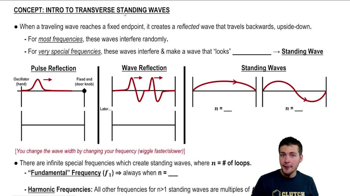
Standing waves are formed when two waves of the same frequency and amplitude travel in opposite directions and interfere with each other. In an open-closed tube, the open end allows for maximum displacement (antinodes), while the closed end has no displacement (nodes). Understanding the formation of standing waves is crucial for analyzing sound waves in tubes.
Recommended video:
Guided course
07:58
Intro to Transverse Standing Waves

Harmonics in Open-Closed Tubes

In an open-closed tube, only odd harmonics are present due to the boundary conditions imposed by the open and closed ends. The fundamental frequency (first harmonic) has one antinode at the open end and one node at the closed end. Higher harmonics can be calculated as odd multiples of the fundamental frequency, which helps determine the number of pressure antinodes in the tube.
Recommended video:
Guided course
18:29
Pressure Gauges: U-Shaped Tube

Wave Speed and Frequency Relationship

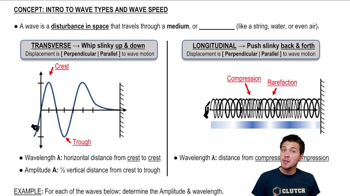
The speed of a wave in a medium is related to its frequency and wavelength by the equation v = fλ, where v is the wave speed, f is the frequency, and λ is the wavelength. In this scenario, knowing the speed of sound and the frequency allows us to calculate the wavelength, which is essential for determining the positions of the pressure antinodes in the tube.
Recommended video:
Guided course
07:19
Intro to Waves and Wave Speed