
Ch 17: Superposition
Knight Calc - Physics for Scientists and Engineers 5th Edition
Knight Calc5th EditionPhysics for Scientists and EngineersISBN: 9780137344796Not the one you use?Change textbook
Chapter 17, Problem 17

The fundamental frequency of an open-open tube is 1500 Hz when the tube is filled with 0°C helium. What is its frequency when filled with 0°C air?

Verified step by step guidance
1
Identify the relationship between the speed of sound in a medium and the frequency of sound. The speed of sound in a medium is given by the formula: \( v = f \lambda \), where \( v \) is the speed of sound, \( f \) is the frequency, and \( \lambda \) is the wavelength.
Understand that the wavelength of the fundamental frequency in an open-open tube is twice the length of the tube, i.e., \( \lambda = 2L \). Since the tube's length and the type of its ends (open-open) remain constant, the wavelength for the fundamental frequency does not change.
Use the formula for the speed of sound in a gas, which is \( v = \sqrt{\frac{\gamma R T}{M}} \), where \( \gamma \) is the adiabatic index, \( R \) is the universal gas constant, \( T \) is the temperature in Kelvin, and \( M \) is the molar mass of the gas. Note that for helium and air at the same temperature, the difference in molar mass will affect the speed of sound.
Calculate the speed of sound in both helium and air using their respective molar masses. Helium has a molar mass of about 4 g/mol, and air has a molar mass of about 29 g/mol. Since the temperature and other constants remain the same, the speed of sound will be higher in helium due to its lower molar mass.
Apply the relationship between speed of sound and frequency to find the new frequency when the tube is filled with air. Since the wavelength remains constant and the speed of sound in air is lower, the frequency of the sound when the tube is filled with air will also be lower compared to when it is filled with helium.

Verified video answer for a similar problem:

This video solution was recommended by our tutors as helpful for the problem above.
Video duration:
3m
Was this helpful?

Key Concepts

Here are the essential concepts you must grasp in order to answer the question correctly.

Fundamental Frequency

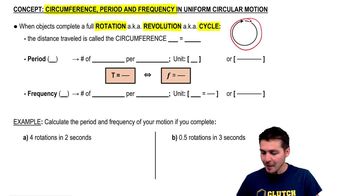
The fundamental frequency is the lowest frequency at which a system oscillates. In the context of a tube, it is determined by the length of the tube and the speed of sound in the medium inside it. For an open-open tube, the fundamental frequency can be calculated using the formula f = v/2L, where v is the speed of sound in the medium and L is the length of the tube.
Recommended video:
Guided course
05:08
Circumference, Period, and Frequency in UCM

Speed of Sound in Different Gases

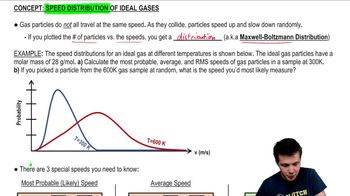
The speed of sound varies in different gases due to differences in density and temperature. In general, sound travels faster in lighter gases like helium compared to heavier gases like air. At 0°C, the speed of sound in helium is approximately 972 m/s, while in air, it is about 331 m/s. This difference significantly affects the fundamental frequency of sound waves in a tube.
Recommended video:
Guided course
07:59
Speed Distribution & Special Speeds of Ideal Gases

Effect of Medium on Frequency

The frequency of sound produced in a tube is directly related to the medium filling the tube. When the medium changes, the speed of sound changes, which in turn alters the fundamental frequency. For an open-open tube, if the medium changes from helium to air, the frequency will decrease due to the lower speed of sound in air compared to helium, demonstrating the relationship between medium properties and sound frequency.
Recommended video:
Guided course
07:40
The Doppler Effect